BPC-157 vs TB-500: Which Recovery Peptide Works Better?
BPC-157 vs TB-500: Which Recovery Peptide Works Better?
BPC-157 and TB-500 are two popular peptides used for recovery and healing. Here's a quick breakdown:
- BPC-157: Best for localized injuries like tendons, ligaments, and gut issues. It works by improving blood flow and activating growth hormone receptors at injury sites. It's stable for oral use and offers fast relief, but requires daily dosing. Costs range from $40–$80/month.
- TB-500: Ideal for systemic healing, such as muscle tears and widespread injuries. It mobilizes repair cells across the body, reducing inflammation and supporting tissue repair. Administered via injection twice weekly, with costs between $80–$150/month.
For severe injuries, combining both in the "Wolverine Stack" can accelerate recovery, addressing both local and systemic needs. However, this approach can cost $140–$200/month.
Quick Comparison
| Attribute | BPC-157 | TB-500 |
|---|---|---|
| Focus | Localized (tendons, gut) | Systemic (muscles, tissues) |
| Mechanism | Blood flow, growth receptors | Cell migration, inflammation |
| Dosing | Daily (oral/injection) | Twice weekly (injection) |
| Cost | $40–$80/month | $80–$150/month |
| Best For | Tendons, ligaments, gut | Muscles, widespread repair |
Choose based on your specific recovery needs: localized vs. systemic. If unsure, consult a medical professional.
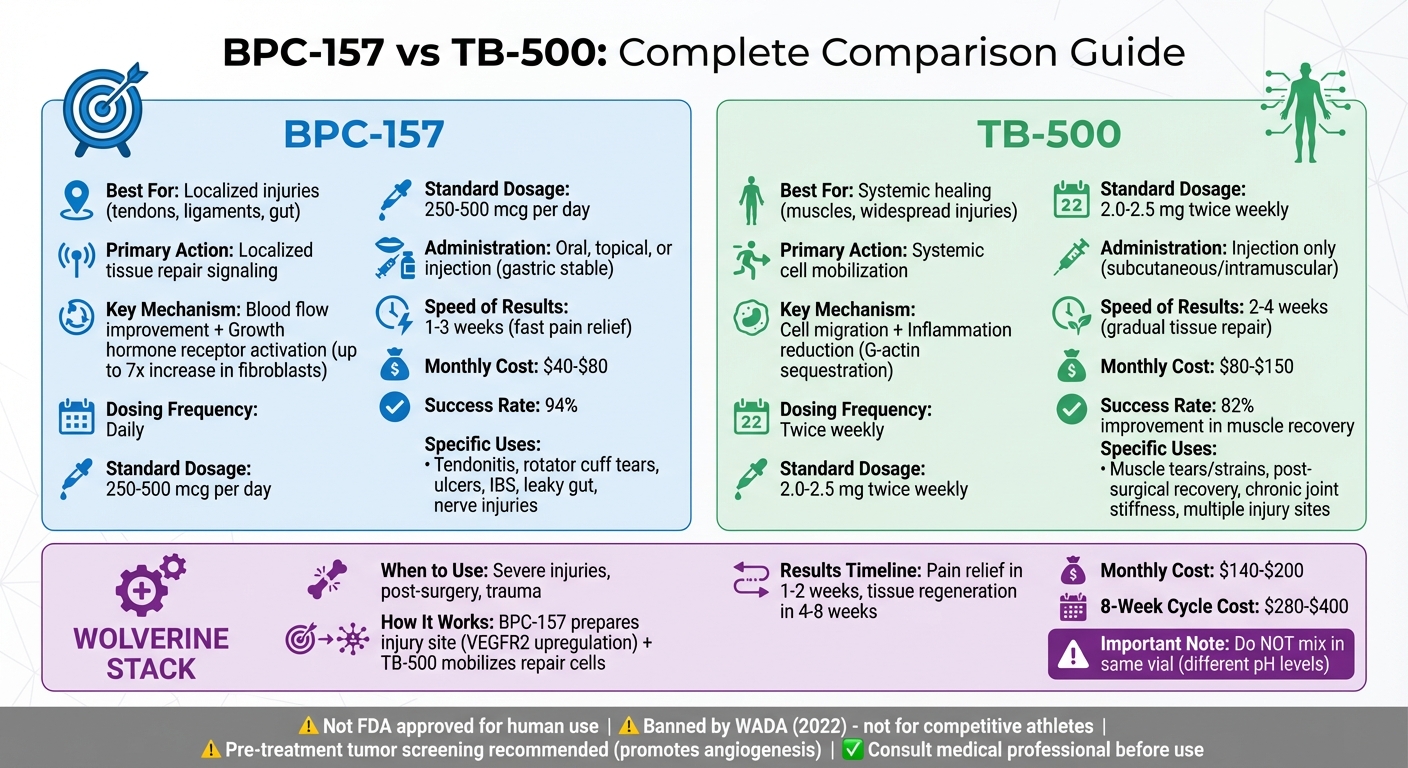
BPC-157 vs TB-500 Peptide Comparison Chart
BPC-157 & TB-500: The Truth About the Wolverine Stack
sbb-itb-7fad836
What is BPC-157?
BPC-157, short for Body Protection Compound-157, is a synthetic peptide derived from a protein naturally present in human gastric juice. This acidic stomach fluid not only helps digest food but also protects the gut lining. BPC-157 is a 15-amino acid fragment designed to mimic the regenerative properties of this natural protein. It was first identified in 1993 by Professor Predrag Sikiric and his team at the University of Zagreb.
Unlike most peptides that break down quickly in stomach acid, BPC-157 remains stable in gastric juice for more than 24 hours.
"BPC-157 was literally discovered in gastric juice. It's what the peptide evolved to do." – Brainflow
Let’s dive into how this peptide works to repair tissue at the cellular level.
How BPC-157 Works
BPC-157 doesn’t directly rebuild tissue. Instead, it activates repair mechanisms within cells, with angiogenesis - forming new blood vessels - being its key process. By increasing levels of Vascular Endothelial Growth Factor (VEGF) and triggering the VEGFR2 pathway, it supports the growth of blood vessels to deliver oxygen and nutrients to damaged tissues.
Additionally, BPC-157 enhances Growth Hormone Receptor levels in fibroblasts, the cells responsible for collagen production and structural repair. Research has shown up to a sevenfold increase in tendon fibroblasts when exposed to BPC-157. It also regulates the nitric oxide (NO) system, aiding blood flow and reducing oxidative damage at injury sites. These actions are essential for cell adhesion, migration, and survival during tissue repair and remodeling.
This cellular activity translates into a range of therapeutic benefits.
Main Benefits
BPC-157 is especially effective for repairing localized tissue, particularly in areas with limited blood supply. For tendons and ligaments, it promotes fibroblast growth and improves collagen organization. Animal studies on Achilles tendon injuries show that BPC-157 can accelerate recovery of tensile strength by 50–70% compared to untreated controls. Its ability to boost Growth Hormone Receptor levels makes it especially valuable for healing slow-repair tissues like tendons.
The peptide is also highly effective in promoting gastrointestinal healing, addressing conditions such as ulcers, inflammatory bowel disease (IBD), and leaky gut syndrome. It protects against damage caused by NSAIDs, alcohol, and ischemia. Its oral bioavailability and stability in the digestive system make it a convenient option for many users.
Beyond tissue repair, BPC-157 supports nerve regeneration and offers neuroprotection. By modulating the NO system and reducing pro-inflammatory cytokines, it helps manage inflammation while preserving the body's natural healing response.
Common Uses
BPC-157 is widely used by athletes and individuals recovering from injuries. It’s particularly sought after for repairing tendons and ligaments, addressing issues like Achilles tendon injuries, rotator cuff tears, and chronic tendinitis. It’s also popular for treating gastrointestinal conditions such as ulcers and IBD. In sports recovery, it helps heal training-related microtrauma and reduces chronic inflammation.
Some users pair BPC-157 with TB-500 in a combination known as the "Wolverine Stack", which typically costs between $140 and $200 per month. For BPC-157 alone, monthly expenses range from $40 to $80 for a 500 mcg/day protocol. An 8-week cycle generally costs $120–$160.
However, availability has recently been impacted. In September 2023, the FDA classified BPC-157 as Category 2, effectively banning it from compounding pharmacies in the United States. This has limited its clinical use.
What is TB-500?
While BPC-157 focuses on localized healing, TB-500 takes a broader approach, working systemically to aid tissue repair across the body.
TB-500 is a synthetic peptide modeled after a segment (amino acids 17–23) of Thymosin Beta-4 (Tβ4), a naturally occurring protein found in nearly all cells of the body. Tβ4 itself makes up about 70–80% of the total beta thymosin proteins in the body.
This peptide is designed to mimic Tβ4's regenerative properties, with modifications that improve its stability. It acts as a systemic healing agent, targeting muscles, tendons, ligaments, and other tissues. Unlike the localized effects of BPC-157, TB-500 works across multiple areas of the body, promoting widespread recovery.
TB-500 is banned for competitive athletes under World Anti-Doping Agency (WADA) regulations. It has a molecular mass of roughly 889 g/mol and is administered via injection due to its rapid breakdown by enzymes.
How TB-500 Works
TB-500’s primary mechanism involves binding to G-actin, which is the monomeric form of actin, a protein crucial for cell structure and movement. By preventing G-actin from forming F-actin filaments, TB-500 helps cells change shape and migrate to injured areas, speeding up tissue repair.
Another key function of TB-500 is its ability to promote angiogenesis, or the formation of new blood vessels, by increasing Vascular Endothelial Growth Factor (VEGF). This improves oxygen and nutrient delivery to damaged tissues. Additionally, it attracts stem and progenitor cells to injury sites, aiding in regeneration. Rather than broadly suppressing inflammation, TB-500 selectively reduces specific pro-inflammatory cytokines like TNF-alpha and IL-1β, while still allowing the acute inflammation needed for recovery. Once injected, TB-500 has a systemic half-life of about 2.5 to 3 hours.
These mechanisms explain its potential for a wide range of therapeutic applications.
Main Benefits
Because TB-500 works throughout the body, it’s particularly effective for treating multiple injuries or deeper tissue damage. Its ability to regulate actin and encourage cell migration helps regenerate muscle fibers and can reduce fibrosis after muscle tears. It also strengthens tendons and ligaments, improving recovery and reducing the risk of adhesions. For wound healing, TB-500 speeds up closure and enhances tensile strength by promoting the movement of keratinocytes and fibroblasts.
In cardiovascular research, TB-500 has shown potential for improving heart function by encouraging new blood vessel growth, reducing damage from heart attacks, and increasing blood flow. This is especially noteworthy since only about 0.5–2% of heart muscle cells regenerate naturally in an uninjured adult heart. Research is also exploring TB-500’s potential in corneal healing and stimulating hair follicle activity.
Common Uses
TB-500 is most often studied for its ability to repair muscle injuries like tears and strains, where enhanced cell migration and tissue remodeling are beneficial. It’s frequently used by athletes and individuals recovering from surgery to improve mobility and manage systemic inflammation. The peptide is also applied in tendon and ligament repair, particularly for cases involving multiple injuries rather than isolated damage.
In research settings, TB-500 is typically given through subcutaneous injections, following a protocol that includes an initial loading phase and a subsequent maintenance phase. Monthly research costs for TB-500 usually fall between $80 and $150, while an 8-week cycle may cost around $160 to $240. When combined with BPC-157 in the "Wolverine Stack", costs increase to roughly $140 to $200 per month.
Proper handling is essential: TB-500 must be reconstituted with bacteriostatic water and stored in a refrigerator once mixed. Its dosing is measured in milligrams (mg), distinguishing it from peptides like BPC-157.
BPC-157 vs TB-500: How They Work
BPC-157 and TB-500 operate through entirely different mechanisms, which explains why they are typically used for addressing distinct types of injuries.
BPC-157 focuses on localized repair by significantly increasing receptor activity. For instance, it can boost Growth Hormone Receptor expression in fibroblasts by up to seven times, enhancing the area’s sensitivity to growth factors. It also promotes angiogenesis by upregulating VEGFR2 receptors, encouraging the formation of new blood vessels to deliver nutrients and oxygen to the injury site. Additionally, BPC-157 impacts the nitric oxide system and activates the FAK-paxillin pathway, which improves blood flow and supports tissue healing.
TB-500, on the other hand, works systemically, mobilizing repair cells throughout the body. Its key action is the sequestration of G-actin, which prevents the formation of rigid F-actin. This process helps maintain cellular flexibility, allowing repair cells like stem cells and keratinocytes to effectively migrate to areas of injury. TB-500 also reduces systemic inflammation by suppressing cytokines such as IL-1β and TNF-α.
"BPC-157 is like a laser-guided missile for repair, zeroing in on a specific, localized injury. On the other hand, TB-500 acts more like a system-wide software update." - Bullit Peptides
When used together, these peptides can speed up recovery by combining localized nutrient delivery with the broad mobilization of repair cells. Research models have shown that using both peptides can lead to up to 50% faster muscle repair compared to not using them at all.
Comparison Table: How They Work
| Mechanism | BPC-157 | TB-500 |
|---|---|---|
| Primary Action | Localized tissue repair signaling | Systemic cell mobilization |
| Blood Vessel Formation | Upregulates VEGFR2 receptors to form new vessels | Upregulates VEGF expression and endothelial migration |
| Cell Migration | Promotes local fibroblast and keratinocyte activity | Sequesters G-actin to allow cells to "crawl" to injury sites |
| Collagen Production | High; specifically increases collagen in tendons/ligaments | Moderate; focuses more on flexible tissue remodeling |
| Inflammation Reduction | Modulates nitric oxide system and local cytokines | Suppresses systemic cytokines like IL-1β and TNF-α |
| Molecular Target | Growth Hormone Receptors (GHR) | G-actin (actin sequestration) |
| Stability | Highly stable; gastric-acid resistant | Moderate; sensitive to digestive enzymes |
These differences highlight why each peptide is tailored to specific recovery needs, offering complementary benefits when used together.
Benefits and Recovery Applications
Deciding between BPC-157 and TB-500 depends on the type of injury you're dealing with. Each peptide has distinct mechanisms, offering targeted and efficient recovery options.
BPC-157: Best for Tendons, Ligaments, and Gut Health
BPC-157 shines when it comes to healing connective tissue injuries and addressing gastrointestinal problems. Research on animal models shows it can cut tendon and ligament recovery time in half, reducing healing periods to just 14–21 days.
Its stability in the digestive system makes it suitable for oral use in treating gut-related conditions. For joint pain, localized injections have delivered extended relief. For example, a 34-year-old woman with IBS followed a 90-day protocol of 0.3 mg daily, reporting noticeable improvements in her symptoms. In another study, a single injection provided knee pain relief lasting over six months for 7 out of 12 participants.
"A torn tendon in the shoulder may benefit more from a localized peptide injection [BPC-157] than from a systemic (whole-body) approach."
– Dr. Lundquist, Active Life Physical Medicine and Pain Center
TB-500: Best for Muscles, Soft Tissues, and Systemic Healing
TB-500 offers a whole-body approach, making it particularly useful for muscle injuries, inflammation, and recovery after surgery. Its ability to mobilize repair cells throughout the body makes it effective for treating muscle strains, stiffness, and even chronic conditions.
In one case, a 45-year-old man with a partial rotator cuff tear used a high-dose combination of BPC-157 and TB-500. Within eight weeks, he experienced pain relief and regained mobility, avoiding the need for surgery. TB-500 also requires less frequent dosing - usually twice a week compared to BPC-157’s daily regimen. Monthly costs for TB-500 typically range from $80 to $150, while BPC-157 costs between $40 and $80.
"TB-500 is particularly beneficial for patients experiencing muscle wasting due to weight loss or chronic illness."
– Dr. Wade McKenna, Founder, Dr. McKenna's Orthopedics and Biologics
Comparison Table: Benefits and Applications
| Condition | Recommended Peptide | Rationale | Monthly Cost |
|---|---|---|---|
| Tendonitis (Achilles, Rotator Cuff) | BPC-157 | Upregulates GH receptors in tendon fibroblasts | $40–$80 |
| Muscle Tear/Strain | TB-500 | Promotes actin polymerization essential for muscle repair | $80–$150 |
| Leaky Gut / IBS | BPC-157 | Gastric stable; promotes mucosal lining repair | $40–$80 |
| Post-Surgical Recovery | Both (Wolverine Stack) | Addresses both local trauma and systemic recovery needs | $120–$200 |
| Chronic Joint Stiffness | TB-500 | Enhances cell migration and reduces systemic inflammation | – |
| Nerve Injury | BPC-157 | Demonstrated neuroprotective and regenerative effects | $40–$80 |
This table provides a clear breakdown of the benefits, helping you choose the right peptide to support your recovery journey.
Head-to-Head Comparison
When deciding between BPC-157 and TB-500, understanding their practical differences is just as important as knowing the science behind them. One key distinction lies in how often they're administered: BPC-157 is taken daily due to its short half-life (about 15–30 minutes), while TB-500 is injected twice weekly since it stays active in the body longer.
The timing of results also varies. BPC-157 typically provides pain relief within 1 to 3 weeks, making it a solid choice for quicker symptom relief. On the other hand, TB-500 works more slowly, with tissue repair becoming noticeable within 2 to 4 weeks. This makes BPC-157 better suited for acute pain, while TB-500's systemic effects are ideal for addressing chronic conditions.
Another difference is how they're administered. BPC-157 offers flexibility - it’s stable in stomach acid for up to 24 hours, meaning it can be taken orally, applied topically, or injected subcutaneously or intramuscularly. Meanwhile, TB-500 must be injected because it breaks down in the digestive system. These differences matter when tailoring treatment to specific recovery needs.
Interestingly, these peptides are often used together in what’s called the "Wolverine Stack." This combination works synergistically: BPC-157 enhances VEGFR2 receptor activity at the injury site, while TB-500 promotes cell migration and repair throughout the body. However, it’s crucial to avoid mixing them in the same vial, as their different pH levels can cancel out their effects.
To summarize these differences, here’s a comparison table highlighting their key attributes:
Comparison Table: Key Attributes
| Attribute | BPC-157 | TB-500 |
|---|---|---|
| Tissue Focus | Tendons, ligaments, gut, and nerves | Muscles, skin, and cardiac tissue |
| Inflammation | Localized anti-inflammatory signaling | Systemic reduction of cytokines (IL-1β, TNF-α) |
| Mechanism | Angiogenesis & VEGFR2 upregulation | Actin sequestration & cell migration |
| Dosing Frequency | Daily | Twice weekly |
| Standard Dosage | 250–500 mcg per day | 2.0–2.5 mg twice weekly |
| Speed of Results | 1–3 weeks (fast pain relief) | 2–4 weeks (gradual tissue repair) |
| Injection Type | Localized (near injury) or systemic | Systemic (subcutaneous/intramuscular) |
| Oral Viability | Yes (gastric stable) | No (degraded by digestive enzymes) |
| Monthly Cost | $40–$80 | $80–$150 |
| Synergy (Stacking) | Prepares the site (via VEGFR2 upregulation) | Mobilizes repair cells to the site |
These distinctions highlight how each peptide caters to different recovery needs, making it easier to choose the right one - or use both effectively in combination.
Which Peptide is Right for You?
Let’s break down how to choose the right peptide for your recovery needs based on their specific roles and benefits.
When it comes to healing tendon, ligament, or joint injuries - or even addressing gut issues like ulcers or IBD - BPC-157 is the go-to option. This peptide works by targeting injury sites directly and increasing growth hormone receptor activity in those areas, making it perfect for focused recovery efforts. Plus, it’s stable enough for oral use, offering a needle-free alternative for those who prefer not to deal with injections.
On the other hand, TB-500 is better suited for systemic healing. If you’re dealing with muscle tears or multiple injury sites, this peptide shines by enhancing cell repair throughout the body. Its key mechanism involves promoting actin polymerization, which is critical for repairing muscle fibers and tissues effectively.
For more severe injuries - like post-surgery recovery or trauma - the Wolverine Stack combines the strengths of both peptides. BPC-157 handles localized healing, while TB-500 supports widespread repair by mobilizing the body’s repair cells. Anecdotal evidence suggests this combination can reduce pain in as little as 1–2 weeks, with visible tissue regeneration occurring within 4–8 weeks. However, this approach comes at a cost, running about $140–$200 per month, and requires separate injections for each peptide.
These distinctions can help you align your choice with your specific recovery goals.
What to Consider
Before deciding, take a moment to weigh these factors. Your recovery priorities - whether it’s gut health, muscle repair, or overall healing - should guide your choice.
- Gut health: BPC-157 is the clear choice here. Derived from gastric juice, it has strong evidence supporting its ability to repair the gut lining.
- Muscle repair: TB-500 is ideal for muscle tears, as its mechanism directly supports muscle fiber recovery.
- Steroid therapy support: If you’re on long-term steroids, BPC-157 may help counteract muscle wasting and bone density loss, as highlighted by Dr. Wade McKenna, Founder of Dr. McKenna's Orthopedics and Biologics.
It’s also important to note that both peptides promote angiogenesis, which means they encourage the formation of new blood vessels. Because of this, pre-treatment tumor screening is recommended. Additionally, neither peptide has FDA approval for human use, and they were both banned by the World Anti-Doping Agency (WADA) in 2022. Competitive athletes should avoid these peptides.
Finally, consider the practical aspects of dosing. BPC-157 requires daily injections, while TB-500 is administered twice weekly. Choose the regimen that best fits your lifestyle and treatment preferences.
Conclusion
Deciding between BPC-157 and TB-500 depends on understanding their specific benefits. BPC-157 works best for targeting localized injuries, particularly in tendons, ligaments, and the gut, offering precise support where it's needed most. On the other hand, TB-500 is more effective for promoting widespread healing, especially for muscle tears and reducing inflammation throughout the body.
Clinical studies highlight their unique advantages. For instance, BPC-157 has shown a 94% success rate in treating various injuries, while TB-500 has demonstrated an 82% improvement in muscle recovery.
For more complex injuries, the Wolverine Stack combines the strengths of both peptides. BPC-157 enhances blood supply essential for healing, while TB-500 supports cellular migration and tissue repair. This combined approach typically costs between $280 and $400 for an 8-week cycle.
FAQs
Which injuries respond best to BPC-157 vs TB-500?
BPC-157 works best for localized injuries like tendon or ligament damage and healing gut tissue. Its primary focus is on repairing soft tissues and reducing inflammation in specific areas.
TB-500, however, is more effective for systemic recovery. It aids in muscle injury repair, promotes cell migration, and supports tissue regeneration across the body. This makes it ideal for addressing broader musculoskeletal problems and widespread inflammation.
When deciding between the two, consider the nature of your injury: Is it localized or does it require support for widespread recovery?
Can I stack BPC-157 and TB-500 safely?
Yes, combining BPC-157 and TB-500 is often considered safe and is a popular approach to boost recovery. These two peptides complement each other: BPC-157 focuses on localized tissue repair and helps with blood vessel growth, while TB-500 supports broader healing by promoting cell migration and systemic recovery. Together, they can provide a more well-rounded recovery process. That said, it's always important to consult a healthcare professional to ensure this combination aligns with your individual health needs.
What are the main risks and side effects of these peptides?
The risks and side effects of BPC-157 and TB-500 aren't fully clear because clinical research on these peptides is still limited. Some possible side effects might include localized irritation, inflammation, or allergic reactions, particularly if they're not used correctly. Since these compounds are mostly studied in research settings, their long-term effects on humans remain unknown. If you're considering their use, it's essential to consult a medical professional.