CJC-1295 vs Ipamorelin: Growth Hormone Peptide Comparison
CJC-1295 vs Ipamorelin: Growth Hormone Peptide Comparison
CJC-1295 and Ipamorelin are two peptides used to stimulate natural growth hormone (GH) release, but they work differently and cater to distinct goals:
- CJC-1295: Increases GH production over time by acting on GHRH receptors. It has a long-lasting effect (up to 6–8 days) and is ideal for muscle growth, anti-aging, and improving body composition.
- Ipamorelin: Triggers quick GH pulses by mimicking ghrelin. It works within hours, making it suited for fat loss, recovery, and sleep improvement. It requires more frequent dosing (1–3 times daily).
Combination Use: When used together, these peptides amplify GH release, combining CJC-1295’s sustained effect with Ipamorelin’s quick bursts for a stronger overall result.
Quick Comparison
| Feature | CJC-1295 (with DAC) | Ipamorelin |
|---|---|---|
| Primary Role | Sustains GH levels | Quick GH pulses |
| Half-Life | 6–8 days | ~2 hours |
| Dosing Frequency | 1–2× weekly | 1–3× daily |
| Best For | Muscle growth, anti-aging | Fat loss, recovery, sleep |
| Side Effects | Flushing, low BP | Mild drowsiness, appetite |
| Monthly Cost | $100–$180 | $80–$150 |
For convenience and steady results, CJC-1295 is a better choice. For short-term recovery and fat loss, Ipamorelin stands out. Combining both offers a synergistic boost to GH levels for enhanced benefits.
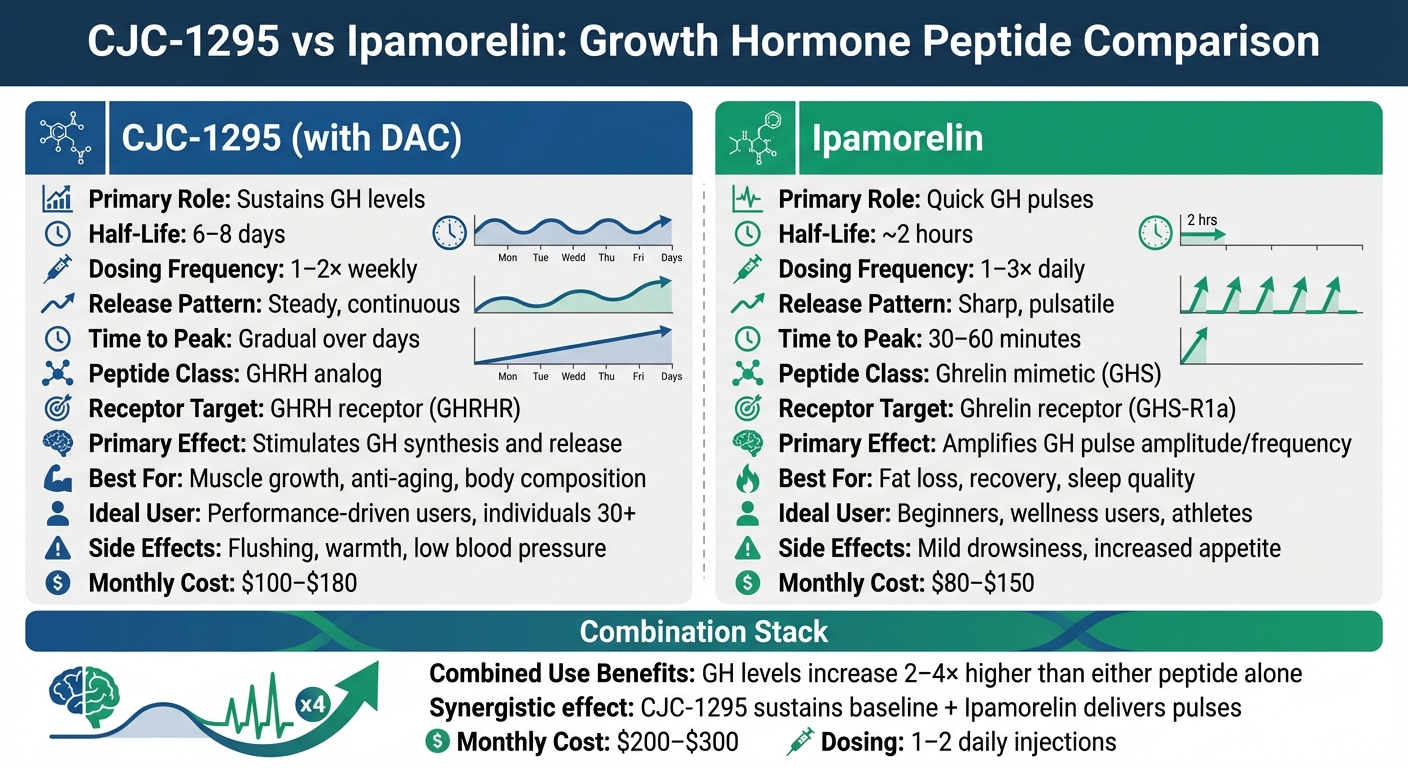
CJC-1295 vs Ipamorelin: Complete Peptide Comparison Chart
How Each Peptide Works
Ipamorelin's Ghrelin Receptor Pathway
Ipamorelin mimics ghrelin, often called the "hunger hormone", by binding to ghrelin receptors (GHS-R1a) in the pituitary gland. This interaction triggers the activation of phospholipase C, which mobilizes calcium within cells. The result? Growth hormone (GH) vesicles fuse and release GH into the bloodstream.
What sets Ipamorelin apart from older peptides like GHRP-6 is its selectivity. A 1998 study by Raun et al., published in the European Journal of Endocrinology, showed that Ipamorelin stimulates GH release as effectively as GHRP-6 but with significantly lower cortisol and ACTH responses. In fact, Ipamorelin produced no significant elevation of cortisol or ACTH, in contrast to GHRP-6, even at doses far exceeding the effective GH-releasing dose.
"Ipamorelin released GH from pituitary cells with potency comparable to GHRP-6... but produced no significant elevation of ACTH or cortisol." – Raun et al., European Journal of Endocrinology
Additionally, Ipamorelin suppresses somatostatin, which allows for more pronounced GH pulses. Since ghrelin receptors are found throughout the body, this peptide may also influence digestion, cognitive reward systems, and even sleep cycles.
Next, let’s look at how CJC-1295 takes a different route to enhance GH levels.
CJC-1295's GHRH Pathway
Unlike Ipamorelin, which triggers the release of stored GH, CJC-1295 promotes the production of new GH molecules. As a GHRH analog, CJC-1295 binds to GHRH receptors (GHRHR) in the anterior pituitary. This activates the cAMP/protein kinase A pathway, leading to increased GH gene transcription and the synthesis of fresh GH.
Think of Ipamorelin as a switch that releases stored GH, while CJC-1295 acts more like a factory manager, ramping up production. This difference explains why CJC-1295 tends to create a more sustained increase in GH levels, especially when combined with a Drug Affinity Complex (DAC) to extend its activity.
A 2006 clinical study by Lucian Ionescu and Lawrence Frohman tested CJC-1295 (with DAC) on 21 healthy adults. Subcutaneous doses of 30–120 mcg/kg led to dose-dependent increases in GH levels, reaching up to 10 times the baseline. IGF-1 levels also rose 1.5–3 times over seven days.
"Pulsatile secretion of growth hormone (GH) persists during continuous stimulation by CJC-1295." – Ionescu and Frohman, Journal of Clinical Endocrinology & Metabolism
While Ipamorelin enhances the frequency and strength of existing GH pulses, CJC-1295 stimulates entirely new GH production. Its specificity for pituitary GHRH receptors ensures minimal off-target effects, making it an efficient option for GH optimization.
Comparison Table: How They Work
Here’s a side-by-side look at the key differences:
| Feature | Ipamorelin | CJC-1295 |
|---|---|---|
| Peptide Class | Ghrelin mimetic (GHS) | GHRH analog |
| Receptor Target | Ghrelin receptor (GHS-R1a) | GHRH receptor (GHRHR) |
| Intracellular Pathway | Phospholipase C / Calcium mobilization | cAMP / Protein Kinase A (PKA) |
| Primary Effect | Amplifies GH pulse amplitude/frequency | Stimulates GH synthesis and release |
| Selectivity | Highly selective; minimal effect on cortisol/prolactin | Selective for pituitary GHRH receptors |
| Half-Life | ~2 hours | ~30 minutes (No DAC) / 6–8 days (With DAC) |
| Release Pattern | Rapid, spike-like pulses | Pulsatile (No DAC) or sustained (With DAC) |
These distinct mechanisms highlight the unique advantages of each peptide, paving the way for their practical use in optimizing GH levels.
sbb-itb-7fad836
What Are CJC 1295 and Ipamorelin? How They Work + What To Expect
Duration and Release Patterns
The way these peptides are released and act within the body plays a key role in shaping their uses and dosing schedules.
Ipamorelin's Fast-Acting Nature
Ipamorelin has a half-life of about 2 hours, which means it triggers a quick surge in growth hormone (GH) levels, peaking within 30–60 minutes and tapering off within 2–3 hours. Because of this brief activity, it typically requires multiple daily doses - usually 1–3 injections. These are often timed strategically, such as before workouts or during overnight recovery.
"Ipamorelin provides a clean GH surge without unwanted hormonal noise – an important safety and comfort factor." – LIVV Natural
CJC-1295's Long-Lasting Effects
CJC-1295 with DAC stands out for its extended half-life of 6–8 days, offering a steady and prolonged elevation of GH levels. A single injection can maintain increased plasma GH for six days or more, with IGF-1 levels rising for 9–11 days. This makes it suitable for a more relaxed dosing schedule of just 1–2 injections per week. On the other hand, CJC-1295 without DAC (also known as Modified GRF 1-29) has a much shorter half-life of around 30 minutes. It is often paired with Ipamorelin to mimic the natural pulsatile release of GH.
"CJC-1295 and ipamorelin are commonly used together because they have complementary time-release characteristics... the tortoise and the hare as relay partners." – Innerbody Research
Comparison Table: Duration and Release
| Feature | Ipamorelin | CJC-1295 (with DAC) | CJC-1295 (without DAC) |
|---|---|---|---|
| Half-Life | ~2 hours | 6–8 days | ~30 minutes |
| Release Pattern | Sharp, pulsatile | Steady, continuous | Short, pulsatile |
| Dosing Frequency | 1–3× daily | 1–2× weekly | Typically daily |
| Time to Peak | 30–60 minutes | Gradual over days | ~30 minutes |
| GH Elevation Duration | 2–3 hours | Sustained for 6+ days | Brief |
| Estimated Monthly Cost | $80–$150 | $100–$180 | Varies |
These differences in release profiles directly influence how these peptides are used and when they are administered. Their unique characteristics will be further explored in the following section.
Primary Uses and Health Goals
Peptides are often chosen based on how they interact with growth hormone (GH) activity, making it easier to align them with specific health goals. Here's a closer look at two popular options: Ipamorelin and CJC-1295.
Ipamorelin for Fat Loss and Recovery
Ipamorelin is known for its ability to enhance fat metabolism by mimicking the hormone ghrelin, which triggers lipolysis (fat breakdown). Studies show it can reduce fat mass by up to 14% over the course of 12 months. Beyond fat loss, this peptide supports recovery with minimal hormonal interference, delivering sharp GH pulses that improve sleep and overall body composition.
"Ipamorelin is one of the more commonly selected lower-intensity GH-signaling peptides used in wellness-focused settings." – HiTONE Fitness
Another noteworthy benefit is its positive impact on bone health. Ipamorelin encourages bone mineralization and new bone formation. Interestingly, research on rats has shown it can reduce pain perception by up to four times through its effect on neuropeptide Y regulation.
While Ipamorelin focuses on fat loss and recovery, CJC-1295 is more geared toward muscle growth and anti-aging benefits.
CJC-1295 for Muscle Growth and Anti-Aging
CJC-1295 works differently from Ipamorelin by providing prolonged GH elevation, which drives anabolic (muscle-building) processes. This sustained GH release promotes muscle hypertrophy and long-term anti-aging benefits. Research indicates that users experience elevated GH levels for more than six days, along with a 1.5- to 3-fold increase in IGF-1 levels.
These prolonged effects support collagen production, enhance skin elasticity, and improve nitrogen retention - key factors for maintaining muscle and aiding recovery as we age. The consistent anabolic environment created by CJC-1295 is ideal for tissue repair and muscle growth.
"CJC 1295 is generally the preferred option for individuals who want a stronger growth hormone response and are aiming for noticeable changes in body composition or performance." – HiTONE Fitness
CJC-1295 is especially popular among individuals over 30 who are looking to counteract age-related GH decline. It's a great choice for those prioritizing muscle maintenance, performance, and metabolic health. Its sustained release makes it a strong option for long-term goals related to muscle preservation and anti-aging.
Comparison Table: Uses and Goals
| Health Goal | Ipamorelin | CJC-1295 (with DAC) |
|---|---|---|
| Primary Focus | Fat loss, recovery, sleep quality | Muscle growth, anti-aging, body composition |
| Best For | Beginners, wellness users, athletes | Performance-driven users, individuals 30+ |
| GH Impact | Clean, pulsatile release; minimal disruption | Stronger overall GH and IGF-1 response |
| Fat Metabolism | Up to 14% reduction in fat mass over 12 months | Sustained lipolysis via steady GH elevation |
| Muscle Building | Moderate support through IGF-1 spikes | Significant hypertrophy via enhanced nitrogen retention |
| Skin & Collagen | Minimal direct effect | Long-term collagen synthesis support |
| Bone Health | Enhanced mineralization and bone deposition | Moderate support |
| Monthly Cost | $80–$150 | $100–$180 |
Safety and Side Effects
The safety profiles of these peptides differ significantly, offering unique considerations for users.
Ipamorelin's Safety Profile
Ipamorelin is often seen as a milder option due to its targeted action. It triggers growth hormone (GH) release without notably increasing cortisol or prolactin levels, which helps avoid hormonal imbalances.
"Ipamorelin is widely regarded as one of the cleanest and best-tolerated GH secretagogues in modern peptide protocols." – Women's Health & Cosmetic Services of Maryland
Common side effects include headaches, nausea, water retention, and increased appetite - linked to its ghrelin-like activity. Some users may also experience redness or itching at the injection site, but rotating locations (such as the abdomen, thigh, or arm) can reduce irritation. Drowsiness is another reported issue, which can be managed by taking doses in the evening. With a short half-life of about two hours, Ipamorelin leaves the body quickly, making it easier to adjust or stop treatment if needed.
CJC-1295's Safety Profile
CJC-1295 presents different safety considerations, particularly related to cardiovascular effects. It can cause flushing, warmth, and occasional low blood pressure due to its vasodilatory properties, which the FDA has flagged as a concern.
"The FDA warns of the risk of 'increased heart rate and systemic vasodilatory reaction,' including 'flushing, warmth, and transient hypotension.'" – U.S. Food & Drug Administration
In addition to these reactions, CJC-1295 shares side effects with Ipamorelin, such as injection-site irritation, headaches, and water retention. The peptide comes in two forms: CJC-1295 with DAC, which has a long half-life of 5.8 to 8.1 days, and a non-DAC version (Mod GRF 1-29) that lasts only about 30 minutes. The extended activity of the DAC formulation means it stays active for days, limiting the ability to quickly adjust the protocol if side effects develop.
Both peptides are not recommended for individuals with active or recent cancer, as they may promote tumor growth. Additionally, both carry risks of affecting insulin sensitivity, which is particularly relevant for people with uncontrolled diabetes. A cycling approach - such as three months on and one month off - is advised to prevent pituitary desensitization.
Understanding these safety profiles is essential for choosing the right peptide based on individual health needs and risk tolerance. These factors, combined with efficacy considerations, help guide informed decisions.
Comparison Table: Safety Profiles
| Safety Factor | Ipamorelin | CJC-1295 (with DAC) |
|---|---|---|
| Hormonal Selectivity | High; minimal impact on cortisol and prolactin | Moderate; may affect heart rate and blood pressure |
| Common Side Effects | Injection-site irritation, headaches, nausea, water retention, increased appetite | Injection-site irritation, headaches, water retention, and tingling |
| Unique Reactions | Mild drowsiness (manageable with evening dosing) | Vasodilatory reaction (flushing, warmth, occasional low blood pressure) |
| Half-Life | ~2 hours | 5.8–8.1 days |
| Flexibility to Stop | High – quick clearance | Low – remains active for days |
| Cancer Risk | Contraindicated with active malignancy | Contraindicated with active malignancy |
| Cardiovascular Concerns | Minimal | Increased heart rate, transient hypotension |
| FDA Safety Status | Prohibited in compounding (FDA bulk drug substance list) | Flagged for Significant Safety Risk |
Choosing Between Ipamorelin and CJC-1295
When deciding between these two peptides, it’s all about aligning their unique characteristics with your personal health goals, lifestyle, and comfort with injection routines.
Selection Factors
Injection frequency is a key consideration. CJC-1295 with DAC stands out for its convenience, requiring only 1–2 injections per week thanks to its 6–8 day half-life. On the other hand, Ipamorelin has a much shorter duration of action - just 2–3 hours - so it typically needs 1–3 daily injections. While this may seem like a hassle, it allows users to time doses strategically, such as around workouts, meals, or bedtime, to maximize benefits like improved recovery and sleep.
Your health goals also play a major role. Ipamorelin is often the go-to for beginners looking to improve sleep, speed up recovery after exercise, and avoid hormonal side effects like elevated cortisol or prolactin. Meanwhile, CJC-1295 is better suited for those aiming for more dramatic improvements in body composition, muscle growth, or anti-aging effects. Its less frequent dosing schedule also appeals to those who prefer simplicity
Finally, cost is a practical factor to weigh when choosing the best option for your needs.
These considerations lay the groundwork for understanding how combining these peptides can amplify their effects.
Combining Both Peptides
For a more robust growth hormone (GH) boost, using Ipamorelin and CJC-1295 together is a popular strategy. This combination works because the peptides activate different pathways: Ipamorelin targets the ghrelin receptor, while CJC-1295 acts on the GHRH pathway. Studies show this synergy can produce GH levels 2–4 times higher than using either peptide alone, with some research reporting increases of 3–8 times above baseline.
Here’s why this pairing works so well: CJC-1295 raises baseline GH levels, while Ipamorelin delivers strong, short-lived pulses. As one expert puts it:
"Ipamorelin delivers the quick signal, while CJC-1295 helps sustain it."
For stacking, many users opt for CJC-1295 without DAC (also called Mod GRF 1-29) because it better maintains the body’s natural pulsatile rhythm and reduces the risk of receptor desensitization.
This stack typically costs between $200 and $300 per month and involves 1–2 daily injections, often timed in the morning and before bed. To make things easier, both peptides can be combined in the same syringe. This approach is especially appealing for those looking to enhance muscle recovery, burn fat more effectively, improve sleep, and enjoy anti-aging benefits.
Conclusion
When deciding between these peptides, it all comes down to your health and fitness goals. Both options offer unique benefits based on how they work and what they target. CJC-1295 promotes steady growth hormone (GH) production through the GHRH pathway, maintaining elevated GH levels for 6–8 days. On the other hand, Ipamorelin triggers quick, natural GH pulses via the ghrelin receptor pathway and has a shorter half-life of about 2 hours.
If you're looking for convenience and long-lasting effects, CJC-1295 only requires twice-weekly injections and supports fat loss and muscle growth over time. But if your focus is on precision, recovery, and anti-aging, Ipamorelin may be the better option. Its selective action minimizes side effects - like producing 90% less cortisol compared to older GH secretagogues - though it does require 2–3 injections daily. For those seeking the best of both worlds, combining these peptides can deliver even greater results. Studies show that using them together can amplify GH production by 2–4 times compared to using either alone.
In terms of cost, you can expect to spend around $80–$150 per month for Ipamorelin, $100–$180 for CJC-1295, or $200–$300 for the combined stack. These price points reflect the potential benefits each option offers, helping you tailor your choice to your specific needs.
Whether you pick one peptide or decide to combine both, your approach should align with your priorities - whether that’s recovery, muscle growth, or overall wellness.
FAQs
How long until you notice results with CJC-1295 or Ipamorelin?
Results from using CJC-1295 or Ipamorelin tend to appear gradually over several weeks. Early benefits, like improved sleep, quicker recovery, and increased energy, might become noticeable within the first 1–2 weeks. However, more pronounced changes - such as reduced body fat, muscle growth, and enhanced body composition - typically require 4–6 months of consistent use. While you may see some progress within the first month, the more transformative results take time to fully develop.
Do these peptides affect insulin sensitivity or blood sugar?
CJC-1295 and Ipamorelin both have the potential to affect insulin sensitivity and blood sugar levels, though they do so in different ways. CJC-1295 works by boosting growth hormone and IGF-1, which over time might influence insulin resistance. On the other hand, Ipamorelin can prompt the body to release more insulin, but its impact on insulin sensitivity is generally less significant. To address any possible changes in blood sugar or insulin resistance, it's important to have proper monitoring and work closely with a healthcare professional.
Should you use CJC-1295 with DAC or without DAC?
When pairing CJC-1295 with Ipamorelin, it's best to use the No-DAC version. This form works with your body's natural growth hormone (GH) rhythms, offering a shorter and more controlled release. It aligns well with Ipamorelin's quick stimulation of GH. On the other hand, the DAC version causes prolonged GH elevation and is generally used on its own. For optimal synergy with Ipamorelin, stick to the No-DAC form.