Peptides for Muscle Growth: The Ultimate Evidence-Based Guide
Peptides for Muscle Growth: The Ultimate Evidence-Based Guide
Peptides are gaining attention as a safer alternative to steroids for muscle growth. These short chains of amino acids stimulate the body's natural processes, primarily by boosting Growth Hormone (GH) and Insulin-like Growth Factor 1 (IGF-1) levels. Unlike steroids, peptides don't suppress testosterone or cause liver damage, making them a popular choice for fitness enthusiasts and aging individuals.
Key takeaways:
- How they work: Peptides like CJC-1295 and Ipamorelin increase GH and IGF-1, promoting muscle repair, protein synthesis, and fat loss.
- Results: Clinical studies show lean muscle gains of 1–3 kg over 3–12 months.
- Popular options: CJC-1295 (long-lasting GH stimulator), Ipamorelin (selective GH releaser), and BPC-157 (tissue repair).
- Costs: Beginner stacks range from $150–$220/month, far cheaper than HGH therapy.
- Safety: Generally well-tolerated, but long-term data is limited. Always consult a healthcare provider before use.
This guide explores how peptides work, dosing tips, and the best options for muscle growth, recovery, and performance. You can also explore peptide recommendations by health goal to find the best options for your specific needs.
How Peptides Work for Muscle Growth
Peptides and Protein Synthesis
Peptides like CJC-1295 and Ipamorelin play a key role in muscle growth by signaling the pituitary gland to release Growth Hormone (GH). This release indirectly increases IGF-1 levels, which bind to muscle receptors and activate the PI3K-Akt-mTOR pathway. This pathway is crucial for protein synthesis, as it instructs ribosomes to create new muscle proteins, improves amino acid uptake, and enhances glycogen storage for energy.
"IGF-1 is the actual muscle-building signal - it stimulates muscle protein synthesis, promotes satellite cell activation, and reduces protein breakdown." - Pure Peptide Clinic
Some peptides, such as IGF-1 LR3, skip the GH release step entirely. Instead, they directly bind to muscle receptors, activating satellite cells - dormant muscle stem cells. These cells multiply and merge with existing muscle fibers, leading to hypertrophy, or an increase in muscle fiber size.
GH also shifts the body's metabolism to burn fat instead of relying on amino acids for energy. This protein-sparing effect ensures that amino acids remain available for muscle repair and growth. By combining GHRH analogs (which increase GH levels per pulse) with GHRPs (which boost pulse frequency), GH release can be amplified by 3–10 times compared to using one type alone.
This sets the stage for understanding how targeted GH release can further enhance muscle-building effects.
Growth Hormone Release
GH-releasing peptides stimulate the pituitary gland to naturally release GH. These peptides fall into two main categories: GHRH analogs like CJC-1295 and Sermorelin, which increase the strength of natural GH pulses, and GHRP/Ghrelin agonists like Ipamorelin and GHRP-6, which trigger rapid GH release while suppressing somatostatin, the hormone that inhibits GH production.
Here’s how different peptide classes contribute to muscle growth:
| Peptide Class | Example Compounds | Impact on Muscle |
|---|---|---|
| GHRH Analogs | CJC-1295, Sermorelin, Tesamorelin | Sustained IGF-1 levels; improved protein synthesis |
| GHRP / Ghrelin Agonists | Ipamorelin, GHRP-2, GHRP-6 | Faster recovery; activation of satellite cells |
| IGF-1 Variants | IGF-1 LR3, IGF-1 DES | Direct anabolic effects; faster hypertrophy |
"GHRH peptides prolong the natural GH pulse, not override it. This preserves the body's feedback systems and avoids receptor desensitization." - The Peptide Catalog
Unlike synthetic HGH, peptides work with your body’s natural rhythm, avoiding receptor desensitization and maintaining feedback loops. For example, in a 12-month study, the oral secretagogue MK-677 increased fat-free mass by an average of 1.6 kg, while Tesamorelin, an FDA-approved GHRH analog, showed an average lean body mass increase of 1.42 kg.
Faster Recovery and Reduced Inflammation
Peptides do more than just stimulate muscle growth - they also speed up recovery. BPC-157 and TB-500, for instance, enhance muscle repair by promoting angiogenesis and regulating the actin cytoskeleton. BPC-157 boosts healing by activating VEGF and increasing fibroblast activity for collagen production. TB-500, on the other hand, organizes cellular "scaffolding", allowing repair cells to efficiently reach injury sites.
"The actin cytoskeleton is the 'scaffolding' inside cells. By regulating actin, TB-500 helps cells migrate, divide, and reorganize - all critical for wound healing." - The Peptide Catalog
These peptides also help manage inflammation. For example, KPV, a tripeptide, reduces inflammation by targeting NF-κB, a key regulator of inflammation, and lowering levels of pro-inflammatory cytokines like IL-1β, IL-6, and TNF-α. Studies suggest peptides can decrease inflammation markers by 30–50% in tissue injury models.
Faster recovery not only restores muscle health but also improves training performance. By stacking recovery peptides with GH secretagogues, healing times can be reduced by 30–50% in animal studies. Additionally, GH secretagogues like Ipamorelin enhance recovery by deepening REM sleep, which is critical for natural tissue repair.
sbb-itb-7fad836
World’s LEADING Peptide Scientist: Peptide Masterclass for Building Muscle | Dr. William Seeds
Top Peptides for Muscle Growth
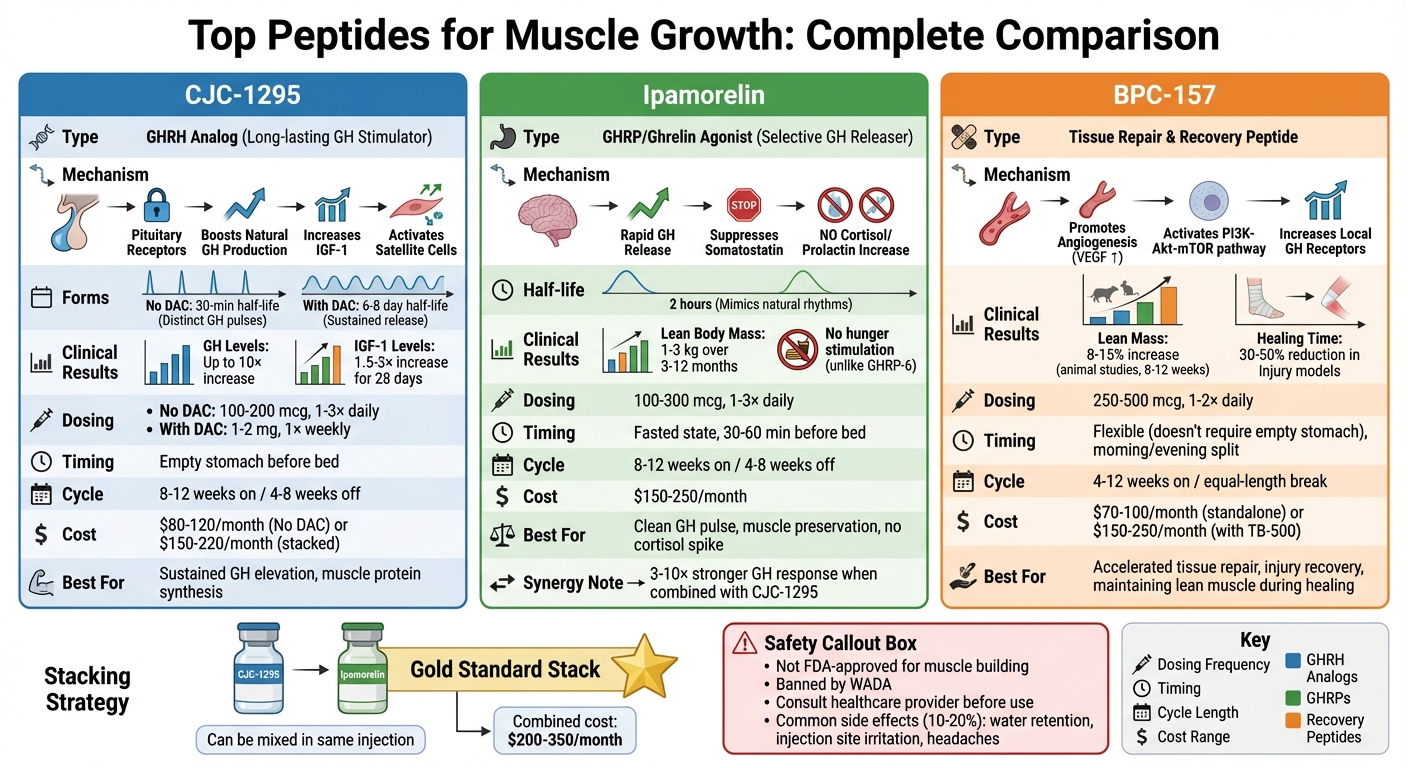
Peptide Types for Muscle Growth: Mechanisms, Dosing, and Results Comparison
Let’s dive into some of the most effective peptides that target muscle growth, detailing how they work and their benefits.
CJC-1295: Long-Lasting Growth Hormone Stimulator
CJC-1295 is a synthetic analog of Growth Hormone-Releasing Hormone (GHRH). It binds to receptors in the pituitary gland, boosting your body’s natural production of growth hormone (GH). The muscle-building effects stem from IGF-1, which is produced by the liver in response to the elevated GH levels. IGF-1 plays a key role in activating satellite cells (muscle stem cells), enhancing protein synthesis, and reducing protein breakdown.
There are two forms of CJC-1295:
- "No DAC" (Modified GRF 1-29): Has a short half-life of about 30 minutes, creating distinct GH pulses.
- "With DAC": Offers a longer half-life of 6–8 days, resulting in sustained GH release.
A 2006 Phase 2 study led by Ionescu and Frohman tested 21 healthy adults. A single injection of CJC-1295 (with DAC) at doses of 30–120 mcg/kg increased mean GH levels by up to 10 times and IGF-1 levels by 1.5 to 3 times for as long as 28 days.
For best results, inject CJC-1295 on an empty stomach before bed to maximize nighttime GH release. Many users combine it with Ipamorelin (100–300 mcg of each) to amplify the GH pulse through dual-receptor stimulation. Monthly costs for CJC-1295 range from $80–$120 (No DAC) or $150–$220 for a stack.
Ipamorelin: Targeted Growth Hormone Releaser
Ipamorelin is a highly selective peptide that stimulates GH release without significantly increasing cortisol, prolactin, or ACTH - side effects often seen with older peptides like GHRP-2 and GHRP-6. This makes Ipamorelin ideal for muscle preservation, as it avoids cortisol-related muscle breakdown.
"Ipamorelin selectively triggers GH release without raising cortisol, prolactin, or ACTH." - Pure Peptide Clinic Editorial Team
Another advantage? It doesn’t stimulate hunger, unlike GHRP-6, which makes it easier to stick to specific dietary goals. Ipamorelin delivers a clean GH pulse with a 2-hour half-life, mimicking the body’s natural rhythms. Research on GH secretagogues reports lean body mass increases of 1–3 kg over 3–12 months.
For optimal use, inject Ipamorelin in a fasted state 30–60 minutes before bed. A typical cycle lasts 8–12 weeks, followed by a break to prevent receptor desensitization. Monthly costs for Ipamorelin range from $150–$250.
BPC-157: Tissue Repair and Recovery
BPC-157 is well-known for its ability to accelerate tissue repair and maintain lean muscle. This peptide promotes angiogenesis - the growth of new blood vessels - by increasing Vascular Endothelial Growth Factor (VEGF), which improves oxygen and nutrient delivery to damaged tissues.
It also boosts local growth hormone receptor expression in injured areas, enhancing the body’s natural repair processes without raising systemic GH levels. Additionally, BPC-157 activates the PI3K-Akt-mTOR signaling pathway, which directly supports protein synthesis. Animal studies show lean mass increases of 8–15% over an 8–12 week period, with healing times reduced by 30–50% in injury models.
"BPC-157 activates several healing pathways." - Pure Peptide Clinic Editorial Team
For tissue repair, inject BPC-157 subcutaneously at a dose of 250–500 mcg once or twice daily, preferably on an empty stomach in the morning or before bed. Cycles typically last 4–12 weeks, followed by an equal-length break. Monthly costs range from $70–$100 for standalone use or $150–$250 when paired with TB-500.
Scientific Evidence for Peptide Effectiveness
Clinical Studies on Growth Hormone Peptides
Research into growth hormone peptides highlights their ability to boost GH (growth hormone) and IGF-1 (insulin-like growth factor 1) levels, though direct evidence for muscle mass gains in healthy athletes is limited. Studies on CJC-1295 and Ipamorelin focus primarily on these hormonal effects rather than their impact on muscle growth.
In March 2006, a Phase 2 randomized, placebo-controlled trial led by S.L. Teichman involved 21 healthy adults aged 21–61. Participants were administered subcutaneous doses of CJC-1295 (30 or 60 μg/kg). The results showed GH levels increased by 2–10 times for at least six days, while IGF-I levels rose 1.5–3 times for 9–11 days. Teichman concluded the peptide was “safe and relatively well tolerated”.
"Subcutaneous administration of CJC-1295 resulted in sustained, dose-dependent increases in GH and IGF-I levels in healthy adults and was safe and relatively well tolerated." - S.L. Teichman, Lead Researcher
Ipamorelin is notable for its selectivity. A 1998 study by Raun et al., published in the European Journal of Endocrinology, tested the peptide on Sprague-Dawley rats. The research confirmed Ipamorelin’s ability to release GH with potency comparable to GHRP-6, but with a critical difference - it did not significantly raise ACTH or cortisol levels, even at doses 200 times higher than the effective GH-releasing dose. This reduced cortisol response minimizes the risk of muscle breakdown linked to elevated cortisol levels.
When it comes to actual muscle gains, studies show lean body mass increases of 1–3 kg over 3–12 months with GH-releasing peptides. For example, a 12-month trial using the oral secretagogue MK-677 (often compared to Ipamorelin) demonstrated a fat-free mass gain of 1.6 kg on average. Similarly, Tesamorelin, the only FDA-approved GHRH analog (used for HIV-associated lipodystrophy), showed an average lean body mass increase of 1.42 kg (95% CI 1.13–1.71) in a meta-analysis of five randomized controlled trials.
For BPC-157, research primarily focuses on tissue repair, especially for tendons and ligaments, rather than muscle hypertrophy. While animal studies are promising, human trials examining its effects on muscle mass remain scarce.
These findings provide a foundation for assessing the safety and regulatory aspects of peptide use.
Safety Profile and Regulatory Status
Understanding the safety and regulatory landscape is just as important as evaluating efficacy, especially when considering peptides for muscle growth.
Short-term studies generally show that growth hormone secretagogues are well-tolerated, but long-term safety data is scarce, particularly regarding risks like cancer or mortality. Side effects reported by about 10–20% of users include water retention, injection site irritation, transient headaches, and numbness or tingling in the extremities. Most of these symptoms subside within 2–3 weeks.
Metabolic effects are another concern. For instance, a study on healthy elderly participants found that 25 mg of daily Ibutamoren increased glucose levels by 25.3% at two weeks and 26.9% at four weeks. This highlights the need for close monitoring of blood glucose and HbA1c levels, particularly for individuals with diabetes or prediabetes.
"GHSs promote pulsatile release of GH that is subject to negative feedback, and may prevent supratherapeutic levels of GH and their sequelae." - John T Sigalos, Baylor College of Medicine
From a regulatory perspective, CJC-1295 and Ipamorelin are not FDA-approved for muscle building or anti-aging purposes. While they are sometimes prescribed off-label by licensed physicians, they are often sold as “research chemicals”. The FDA has flagged these peptides for safety and immunogenicity concerns, listing them as substances with "significant safety concerns" for compounding pharmacies. Additionally, all GHRH analogs and GHRPs are banned at all times by the World Anti-Doping Agency (WADA).
Product quality is another pressing issue. Peptides from unverified sources carry risks such as contamination, inconsistent dosing, and impurities. Consulting a healthcare provider is essential before use, especially for individuals with a history of cancer, cardiovascular issues, or diabetes. Modulating the GH axis can affect cell growth pathways and insulin resistance, making professional guidance critical.
How to Use Peptides for Muscle Growth
These practices build on earlier scientific insights to help maximize muscle growth.
Dosing and Timing Guidelines
To get the most out of peptides, timing and dosing are crucial. For example, growth hormone secretagogues like CJC-1295 and Ipamorelin require strategic scheduling since insulin released after eating can reduce growth hormone release by up to 50%. To counter this, use these peptides on an empty stomach (2–3 hours after eating) and wait 30–60 minutes post-injection before eating again.
The best time to administer these peptides is 15–30 minutes before bed, as this aligns with your body's natural nighttime growth hormone surge during deep sleep. Alternatively, taking them first thing in the morning can help with fat mobilization, as long as you avoid eating for 30–60 minutes afterward.
| Peptide | Typical Dose | Frequency | Cycle Length |
|---|---|---|---|
| CJC-1295 (no DAC) | 100–200 mcg | 1–3× daily | 8–12 weeks on / 4–8 weeks off |
| Ipamorelin | 100–300 mcg | 1–3× daily | 8–12 weeks on / 4–8 weeks off |
| BPC-157 | 250–500 mcg | 1–2× daily | 4–8 weeks on / 2–4 weeks off |
| CJC-1295 (with DAC) | 1–2 mg | 1× weekly | 8–12 weeks on / 4–8 weeks off |
BPC-157 offers more flexibility - it doesn’t need to be taken on an empty stomach and is often split into morning and evening doses to maintain steady levels. In terms of cost, a stack of CJC-1295 and Ipamorelin typically ranges from $200–$350 per month, while BPC-157 alone runs about $150–$250.
Next, let’s explore how combining peptides can amplify results.
Combining Peptides for Better Results
Using multiple peptides together can create a stronger growth hormone response than relying on just one. For example, stacking a GHRH analog like CJC-1295 with a ghrelin mimetic like Ipamorelin activates different pathways, leading to a synergistic effect. Among these, CJC-1295 without DAC (also called Mod GRF 1-29) is often preferred for muscle growth because its short half-life (around 30 minutes) preserves the natural pulsatile release of growth hormone.
"The CJC-1295 + ipamorelin combination has become the de facto standard GH secretagogue stack in clinical practice settings, valued for producing reliable GH elevation with a predictable and manageable side effect profile." – The Peptide Effect
These peptides are chemically compatible, meaning they can be mixed to reduce the number of injections. BPC-157 is another popular addition to support connective tissue recovery, allowing for higher training intensity and volume. To avoid receptor desensitization, some users follow a "5 days on / 2 days off" dosing schedule or run cycles of 8–12 weeks followed by a 4-week break.
Once you’ve planned your peptide strategy, proper storage is key to maintaining their effectiveness.
Storage and Handling Guidelines
Storing peptides correctly is essential to keep them effective. Lyophilized peptides should be refrigerated for 6–12 months or frozen at -20°F for longer storage. Once reconstituted, they should be used within 28 days. This timeframe is based on the preservative properties of 0.9% benzyl alcohol in bacteriostatic water, which prevents bacterial growth after the vial is punctured.
Here’s how to reconstitute and handle peptides safely:
- When reconstituting, direct the bacteriostatic water along the vial wall and swirl gently - avoid shaking, as this can damage peptide bonds.
- Store reconstituted peptides upright in the refrigerator’s main compartment to prevent temperature fluctuations.
- Protect peptides from light by keeping them in their original box or wrapping them in foil, as many are sensitive to UV exposure.
- Label the vial with the reconstitution date to track its 28-day usage window. Always use a sterile needle for each draw to avoid contamination.
Discard any solution that appears cloudy, has visible particles, changes color, or develops an unusual odor. Also, never freeze reconstituted peptides - ice crystals can break peptide bonds, rendering them ineffective.
Conclusion
Main Benefits of Peptides for Muscle Growth
Peptides offer a science-backed way to support muscle development. Clinical trials have shown gains in lean body mass ranging from 1 to 3 kilograms over 3 to 12 months. For instance, esamorelin meta-analysis data report an average lean body mass increase of 1.42 kg across randomized controlled trials in HIV-associated lipodystrophy.
These compounds also improve body composition by promoting fat loss and enhancing sleep quality, which aids natural recovery. Peptides like BPC-157 and TB-500 are particularly effective for speeding up the recovery of tendons, ligaments, and muscles, enabling more frequent and intense training sessions. When GHRH analogs like CJC-1295 are paired with GH secretagogues such as Ipamorelin, they create a synergistic effect, delivering a growth hormone pulse 3 to 10 times stronger than either peptide alone. Unlike direct HGH injections, these peptides work with the body’s natural rhythms, helping maintain pituitary function.
These advantages highlight the importance of using peptides within research-based protocols.
Why Research-Based Practices Matter
Sticking to evidence-based protocols ensures both safety and effectiveness. Reliable clinical data can set realistic expectations and counteract the exaggerated claims often seen in less formal sources. As the Pure Peptide Clinic Editorial Team explains:
"GH-releasing peptides work by telling your pituitary gland to produce more of its own growth hormone. The effects on muscle tissue depend on the peptide, dose, and your training and nutrition."
Research-backed approaches also help identify critical contraindications. For example, individuals with active cancer or a history of cancer should avoid GH and IGF-1 peptides due to their potential to promote tumor growth. Proper protocols - such as cycling peptides for 8 to 12 weeks followed by a washout period - reduce the risk of receptor desensitization and allow for monitoring side effects like insulin resistance or hypoglycemia. Additionally, verifying product purity through Certificates of Analysis and third-party testing safeguards against contamination from unregulated sources.
For more in-depth guidance, explore the additional resources below.
Additional Resources from What Peptide
What Peptide offers a wide range of evidence-based tools and guides to support your peptide use. Resources are organized by health goals, providing detailed peptide profiles, harm reduction tips, and instructions on reconstitution, storage, and subcutaneous injection methods. Research summaries classify compounds by "Evidence Tiers", helping you distinguish between FDA-approved treatments and those supported by preclinical studies.
Other tools include stack analysis for evaluating peptide combinations like CJC-1295 and Ipamorelin, a quiz to match peptides to your goals, and access to independent purity testing services. For continued learning, the site provides updated guides on interpreting research studies, reading lab results, and monitoring biomarkers like fasting glucose and HbA1c for safer long-term use. These resources emphasize the importance of evidence-based practices for achieving optimal muscle growth.
FAQs
How do peptides for muscle growth differ from HGH injections?
Peptides such as CJC-1295 and Ipamorelin work by encouraging the pituitary gland to produce more of the body’s own growth hormone (GH). This approach supports a natural increase in GH production. On the other hand, HGH injections introduce synthetic growth hormone directly into the bloodstream, bypassing the body’s usual regulatory systems.
Peptides are often seen as a gentler method, promoting a steady and regulated increase in GH with fewer potential side effects. Meanwhile, HGH injections can significantly raise GH levels, but this may come with a higher risk of issues like joint discomfort and insulin resistance.
What labs should I monitor while using GH/IGF-1 peptides?
When using GH/IGF-1 peptides, it's important to keep an eye on IGF-1 levels. These levels provide insight into growth hormone activity and help evaluate how well the therapy is working. It's also a good idea to monitor blood glucose and liver function, as peptides can influence metabolism and impact organ health. Regular blood tests play a key role in ensuring safety and catching any potential side effects early. Work with your healthcare provider to create a testing schedule tailored to your treatment plan and overall health.
How do I verify peptide purity before using it?
To ensure the purity of peptides, look for suppliers that provide third-party testing results. Independent lab testing offers an unbiased assessment of quality and purity. Before using a peptide, always confirm that such tests have been conducted to verify its authenticity and safety.