Poor Sleep Quality? How Peptides Can Help You Rest Better
Poor Sleep Quality? How Peptides Can Help You Rest Better
Struggling with sleep? Peptides might offer a solution. Unlike traditional sleep aids, which often sedate and disrupt natural sleep cycles, peptides work with your body's biology to target the root causes of poor sleep - hormonal imbalances, stress, and circadian rhythm issues. Here's a quick breakdown:
- DSIP (Delta Sleep-Inducing Peptide): Boosts deep sleep by enhancing delta-wave brain activity without sedation. Helps regulate cortisol and calm the brain.
- Epitalon: Stimulates natural melatonin production by rejuvenating the pineal gland, improving sleep-wake cycles.
- Pep19: Supports metabolic recovery during sleep by increasing growth hormone release, aiding deep sleep and recovery.
Research shows these peptides can improve sleep quality, extend sleep time, and even address stress-related disruptions. Always consult a healthcare provider for safe use and proper dosing.
Want better sleep? Peptides may help you get there naturally.
Why Sleep Quality Suffers: Root Causes
Hormone Problems That Disrupt Sleep
Hormones play a big role in how well we sleep. When they’re out of balance, getting restful sleep becomes a challenge. For instance, as we age, the pineal gland can calcify, leading to lower natural melatonin production. Instead of relying on synthetic melatonin, Epitalon helps by stimulating the pineal gland to boost your body’s own melatonin levels.
Another common issue is cortisol dysregulation. Chronic stress can cause cortisol levels to stay high in the evening, keeping your brain alert when it should be winding down. DSIP (Delta Sleep-Inducing Peptide) helps counter this by acting on the hypothalamus to suppress ACTH, which reduces cortisol spikes and balances neurotransmitters like GABA and glutamate.
Growth hormone (GH) also plays a key role in sleep. About 70% of daily GH production happens during slow-wave sleep. Unfortunately, GH levels naturally decline by about 14% per decade after age 30, which can disrupt sleep patterns. Peptides like CJC-1295 and Ipamorelin can boost nighttime GH release, improving deep sleep and aiding recovery.
While hormonal imbalances are a big factor, stress is another major culprit behind poor sleep.
How Stress Damages Sleep
Stress doesn’t just make you feel on edge - it also messes with your brain’s ability to relax. It can lead to cortical hyperarousal, where racing thoughts make it hard to drift off. Stress also disrupts the hypothalamic-pituitary-adrenal (HPA) axis, flattening the normal cortisol curve and keeping levels high late into the evening. DSIP helps by acting as a cortisol buffer, calming the brain without disrupting its natural baseline.
"Selank functions as an anxiety gate: it reduces cortical arousal and quiets the stress circuits that block sleep onset, creating the conditions under which the sleep-architecture peptide can express its effects."
Peptides like Selank complement DSIP by tackling the "anxiety gate" - the stress and overactivation that keep you awake. Research shows that DSIP can help alleviate stress-related symptoms, making it easier for your brain to transition into sleep.
Broken Sleep Patterns and Body Clock Issues
Your circadian rhythm relies on consistent signals like exposure to bright daylight (10,000+ lux), complete darkness at night, and regular meal schedules. When these signals are disrupted, your internal clock can lose sync.
Phase misalignment occurs when your body’s master clock doesn’t match your actual sleep-wake schedule. This misalignment can make it hard to fall asleep or wake up at the right times. Peptides like Epitalon and DSIP help realign the circadian rhythm through different mechanisms. Epitalon restores the pineal gland’s ability to produce melatonin naturally. For example, studies on aging primates showed a 1.6-fold increase in nighttime melatonin after using Epitalon. Meanwhile, DSIP enhances your existing sleep drive rather than creating it artificially.
"Think of it as a volume knob that only works when the music is already playing. It amplifies sleep drive that is already present rather than generating it from nothing."
- PeptideFox
Peptides are effective because they work in harmony with your body’s natural processes. By addressing hormonal imbalances, calming stress-induced arousal, and syncing your circadian rhythm, they help restore restful sleep in a way that feels natural and sustainable.
sbb-itb-7fad836
DSIP Peptide: Revolutionizing Sleep, Stress, and Pain Management in Clinical Practice
3 Peptides That Improve Sleep
How DSIP, Epitalon, and Pep19 Peptides Improve Sleep Quality
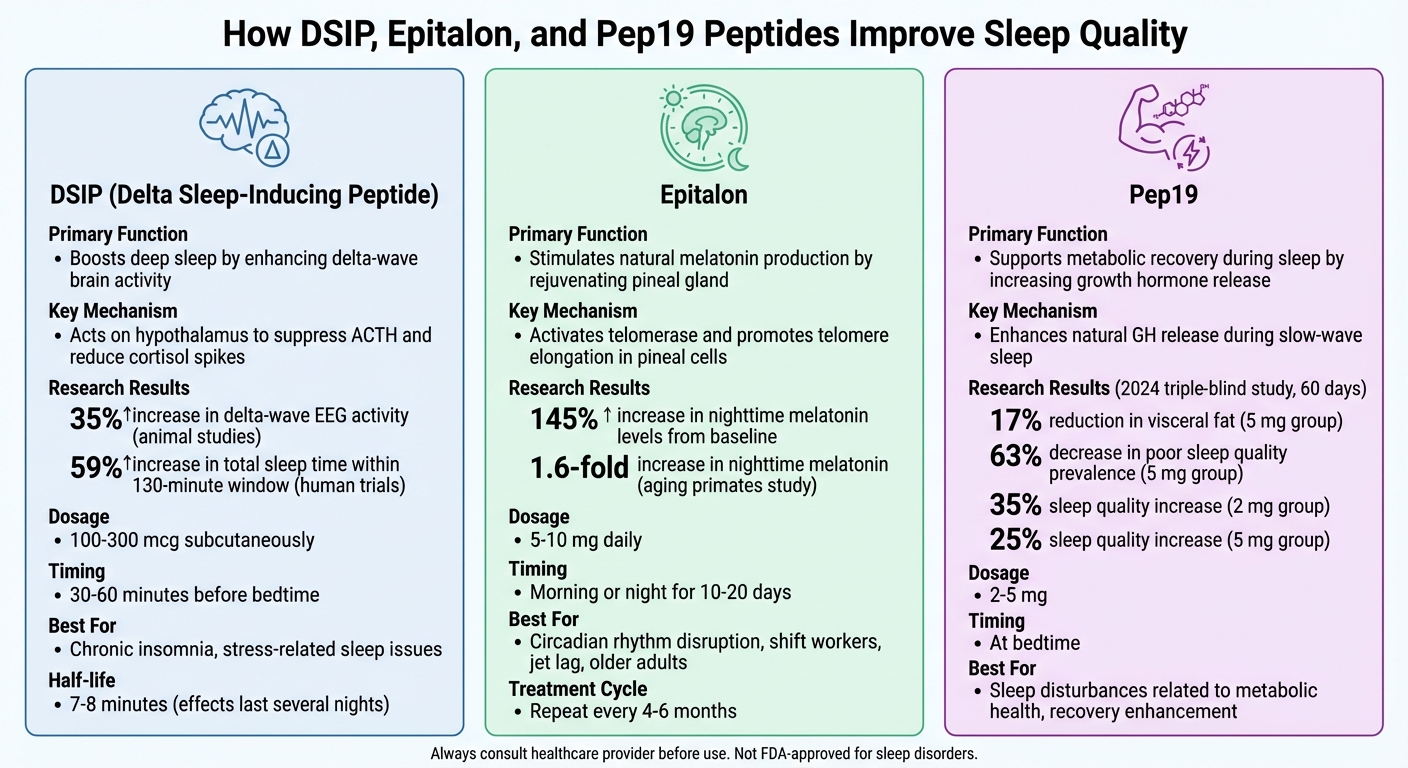
When it comes to tackling issues like hormonal imbalances, stress, and disrupted sleep cycles, three peptides stand out: DSIP, Epitalon, and Pep19.
DSIP (Delta Sleep-Inducing Peptide)
DSIP is a naturally occurring nonapeptide found in areas like the hypothalamus, pituitary gland, and limbic system. It was first identified in 1977 from the cerebral venous blood of rabbits during electrically induced sleep. This discovery linked DSIP to the sleep phase where tissue repair and growth hormone secretion occur.
"DSIP is a neuromodulatory peptide with circadian-dependent effects on sleep architecture. It does not sedate. It does not override wakefulness."
- PeptideFox
Studies show promising results for DSIP. Early animal research revealed a 35% increase in delta-wave EEG activity, while human trials in the 1980s reported a 59% increase in total sleep time within a 130-minute window after administration. Even though DSIP has a plasma half-life of just 7–8 minutes, its effects on sleep patterns can last for several nights. The typical dosage is 100–300 mcg, administered subcutaneously 30–60 minutes before bedtime.
Next up is Epitalon, which takes a different approach to enhancing sleep quality.
Epitalon
Epitalon, a tetra-peptide, works by restoring the pineal gland's natural ability to produce melatonin. Research shows that it can increase nighttime melatonin levels by an impressive 145%. In studies with aged rats, Epitalon helped normalize circadian rhythms and rejuvenate melatonin production.
"Epitalon modulates pineal function and melatonin secretion over longer timeframes. Its relevance is to circadian system integrity - supporting the endogenous melatonin rhythm rather than supplementing exogenous melatonin."
- PeptideFox
Beyond melatonin, Epitalon also activates telomerase, which might reverse age-related calcification of the pineal gland. Typical protocols involve taking 5–10 mg daily for 10–20 days, with treatments repeated every 4–6 months. This peptide is particularly helpful for older adults, shift workers, and frequent travelers dealing with jet lag.
Pep19
Pep19 supports sleep by promoting metabolic balance and enhancing natural growth hormone release during slow-wave sleep. This phase is critical for tissue repair and metabolic recovery. Interestingly, about 70% of daily growth hormone production happens during slow-wave sleep, but levels naturally decline by around 14% per decade after age 30. By boosting growth hormone release at night, Pep19 helps deepen sleep and improve recovery, creating a beneficial cycle between rest and metabolism.
How These Peptides Work in Your Body
These peptides help improve sleep by adjusting key neurotransmitters, resetting your internal clock, and aiding in metabolic recovery.
How DSIP Affects Brain Chemistry
DSIP acts like a fine-tuner for your brain's natural sleep signals. Instead of forcing sleep like traditional sedatives, it strengthens your body's natural sleep drive. It enhances GABA's calming effects while reducing NMDA-driven excitatory signals, creating a better balance in brain activity.
This peptide also boosts serotonin levels in the bloodstream, encourages melatonin production in the pineal gland, and suppresses ACTH to lower cortisol levels - two common obstacles to falling asleep. On top of that, DSIP triggers the release of Met-enkephalin, a natural opioid that helps manage pain and emotional stability without the risk of dependency. Together, these mechanisms encourage delta-wave activity (0.5–4 Hz) and sleep spindle activity, which are the hallmarks of deep, restorative slow-wave sleep.
Next, let’s look at how Epitalon helps realign your internal clock for better sleep.
How Epitalon Resets Your Sleep-Wake Cycle
Epitalon works to reset your body's internal timing system by targeting the pineal gland. It stimulates your body's natural production of melatonin rather than relying on external supplements. This helps restore the natural rhythm of melatonin release.
Additionally, Epitalon activates telomerase and promotes telomere elongation in pineal cells, which may counteract age-related calcification. By rejuvenating the pineal gland's ability to function, it helps reset your master biological clock, aligning your internal rhythms with the natural day–night cycle. This can be particularly useful for shift workers, frequent travelers, or older individuals with reduced melatonin production.
Now, let’s see how Pep19 supports metabolic recovery during sleep.
How Pep19 Supports Sleep Through Metabolism
Although research on Pep19 is still developing, early findings suggest it may enhance sleep quality by influencing metabolic pathways. Pep19 promotes the release of growth hormone during slow-wave sleep, which aids in deeper, more restorative rest. This process also supports tissue repair and overall metabolic recovery.
What Research Shows About Sleep Peptides
Clinical trials have shown that certain peptides can improve sleep quality, particularly for individuals dealing with chronic insomnia or sleep disturbances linked to aging.
DSIP Studies on Insomnia
One notable study from 1986, led by Dietrich Schneider-Helmert at the University of Amsterdam and the Sleep Research Laboratory at the Psychiatric Clinic of Kt. Aargau, examined the effects of DSIP on 18 chronic insomniacs. Participants received intravenous doses of 30 nmol/kg of DSIP six times over a week. By the end of the treatment, middle-aged participants (29–59 years old) achieved normal sleep patterns, while elderly participants (60–83 years old) experienced full normalization after a one-week follow-up period.
Earlier human trials also highlighted DSIP's rapid effects. Participants experienced a 59% increase in total sleep time within a 130-minute window compared to placebo. Despite DSIP's short plasma half-life, its sleep-enhancing effects lasted up to 20 hours. These findings paved the way for investigating other peptides like Epitalon as potential sleep aids.
Epitalon Research on Sleep Patterns
Building on DSIP's success, Epitalon has emerged as another promising peptide for improving sleep. A 2014 study revealed that Epitalon increased nighttime serum melatonin levels by 145% from baseline, while the placebo group showed no measurable changes.
"By stimulating melatonin synthesis, protecting pineal structure, and re-entraining clock genes, Epitalon may counter the widespread circadian drift of aging, with implications far beyond sleep, touching immunity, metabolism, and neuroprotection." - Dr. Herna de Wit, PhD, Healthspan
This ability to restore melatonin production is especially beneficial for older adults whose circadian rhythms are often disrupted by the effects of aging.
Pep19 Studies on Sleep and Body Fat
A recent double-blind, placebo-controlled trial (May–August 2024) examined the effects of Pep19 on both sleep and body composition. The study involved 24 obese adults (BMI 30–35) and was led by Andrea S. Heimann and Dr. Prachi Singh. Participants received either 2 mg or 5 mg of Pep19 at bedtime for 60 days. The 5 mg group experienced a 17% reduction in visceral fat and a 63% decrease in poor sleep quality prevalence.
Improvements in sleep quality were also observed, with a 35% increase in the 2 mg group and 25% in the 5 mg group. Both groups saw reductions in total body weight and waist circumference, while lean body mass remained steady. Dr. Prachi Singh, Associate Professor and Director of the Sleep and Cardiometabolic Health Lab at Pennington Biomedical, remarked:
"The findings are very exciting – Pep19 not only improved sleep but also reduced abdominal fat. This supports the growing understanding that sleep and fat metabolism are deeply interconnected and vital to overall health."
Together, these studies highlight the potential of peptide therapies as targeted tools for improving sleep and overall well-being.
How to Use Sleep Peptides Safely
Using sleep peptides effectively requires careful attention to dosage, timing, and professional oversight. These compounds are research-based and not FDA-approved for treating sleep disorders, so working with a healthcare provider is essential. A professional can monitor your hormonal levels and adjust doses as needed to ensure safety and effectiveness.
Dosing and Timing for Sleep Peptides
Each peptide has its own dosing protocol and timing for optimal results:
- DSIP (Delta Sleep-Inducing Peptide): Start with 100 mcg subcutaneously. The standard dose is 200 mcg, with experienced users sometimes increasing to 300 mcg. Administer DSIP 30–60 minutes before bedtime to sync with your natural sleep cycle. A typical regimen involves 10–30 days of use followed by a 10–20 day break.
- Epitalon: Begin with 5 mg daily. The standard dose is 10 mg, which can be taken either in the morning or at night.
- Pep19: Research suggests doses of 2 mg and 5 mg taken at bedtime may improve sleep quality, particularly for individuals with metabolic health concerns.
Safety Guidelines and Medical Oversight
Once your dosage is set, follow these safety measures to ensure proper administration:
- Common Side Effects: DSIP may cause mild headaches, nausea, dizziness, or temporary warmth at the injection site. Some users also report experiencing more vivid dreams. Unlike many pharmaceutical sleep aids, DSIP has not been linked to dependency, respiratory issues, or withdrawal symptoms.
- Preparation and Storage: Follow sterile reconstitution techniques using bacteriostatic water. Clean vial stoppers with alcohol swabs, and rotate injection sites (abdomen, thigh, or upper arm) to avoid irritation. Store powdered peptides in the freezer, and once reconstituted, refrigerate them between 36–46°F (2–8°C). Use reconstituted peptides within 28 days.
- Who Should Avoid Peptides: These therapies are not recommended for individuals who are pregnant, breastfeeding, under 18, have uncontrolled endocrine issues, or are taking immunosuppressive medications.
Choosing the Right Peptide for Your Sleep Needs
Matching the right peptide to your specific sleep issue is key:
- DSIP: Best suited for chronic insomnia, especially for those who want to avoid sedative effects.
- Epitalon: Helpful for regulating disrupted circadian rhythms.
- Pep19: Targets sleep disturbances related to metabolic health.
For stress-related sleep problems or recovery enhancement, other peptides may offer additional support. Clinical observations indicate that DSIP benefits about 50% of users. However, non-responders may need to address foundational sleep factors first, such as room temperature or light exposure, to see improvements.
Conclusion
Peptides present a science-backed option for improving sleep quality, as highlighted by the research and mechanisms discussed earlier. Options like DSIP, Epitalon, and Pep19 support sleep by addressing underlying issues such as hormonal imbalances, disrupted circadian rhythms, and stress-related disturbances. Unlike traditional sedatives, these peptides work with your body’s natural processes to encourage deep, restorative sleep.
Dr. A. Nagler, MD, sheds light on how these peptides function:
"Peptides for sleep harness the body's existing mechanisms of sleep-wake regulation... It affects neurotransmitter synthesis, hormone secretion cycles and cellular triggers that control real restorative sleep (not drugged unconsciousness)".
When used under professional supervision, peptides can be tailored to specific sleep challenges. For example, DSIP helps improve disrupted sleep patterns, Epitalon supports resetting sleep-wake cycles, and Pep19 aids sleep through its metabolic benefits. However, peptides are most effective when paired with healthy sleep habits - such as maintaining consistent light exposure, keeping your bedroom cool (60–67°F), and timing meals appropriately.
For more research-based insights and guidance on choosing the right peptide for your sleep needs, explore our platform.
FAQs
Which sleep peptide is right for my problem?
When it comes to choosing the best peptide for sleep, it really depends on what's causing your sleep troubles. DSIP (Delta Sleep-Inducing Peptide) could be a good option if stress or irregular schedules are keeping you up. It’s known to encourage deeper sleep without causing sedation or interfering with REM cycles. On the other hand, if your sleep problems are tied to hormonal imbalances or you’re looking to improve your overall sleep quality, CJC-1295 with Ipamorelin might be worth considering. This peptide combination works by boosting growth hormone release, which can lead to better deep sleep.
Make sure to consult with a healthcare professional to figure out which option suits your needs best.
How soon will DSIP or Epitalon improve sleep?
Both DSIP and Epitalon aim to improve sleep, but they work on different timelines. DSIP can deliver noticeable benefits within just a few hours, making it a quicker option for addressing sleep concerns. On the other hand, Epitalon focuses on restoring circadian rhythms, which means its effects usually take several days to weeks to become apparent. Individual factors, such as your body's response and the underlying issue, play a role in how quickly each peptide works.
Can I use sleep peptides with other sleep meds?
Using sleep peptides like DSIP in combination with other sleep medications demands careful consideration and should always be supervised by a healthcare professional. Since research on how these substances interact is still limited, consulting a medical expert is crucial to ensure both safety and effectiveness.