How to Store Peptides Properly: A Step-by-Step Guide
How to Store Peptides Properly: A Step-by-Step Guide
Peptides are sensitive to heat, light, moisture, and oxygen, making proper storage essential to maintain their stability and effectiveness. Here’s what you need to know:
- Lyophilized Peptides (Powder): Store at –20°C (–4°F) for long-term stability (12–24 months) or –80°C (–112°F) for up to 3–5 years. Avoid frost-free freezers due to temperature fluctuations. Let vials warm to room temperature before opening to prevent condensation.
- Reconstituted Peptides (Liquid): Refrigerate at 2–8°C (36–46°F) and use within 28 days. For longer storage, freeze aliquots at –20°C (–4°F) to avoid freeze-thaw cycles.
- Containers: Use amber glass vials to shield from light, and ensure airtight seals to protect against moisture and oxygen. Add desiccants for extra humidity control.
- Handling: Never shake vials; gently swirl instead. Always use sterile tools and label vials with reconstitution dates to track usage.
Key Tip: Protect peptides by keeping them cold, dry, and shielded from light. Proper storage ensures they remain effective and safe for use. Following these peptide harm reduction practices is essential for maintaining research integrity.
The Complete Peptide Storage & Handling Guide for Beginners
sbb-itb-7fad836
Step 1: Know What Form Your Peptides Are In
Before diving into storage and handling, it’s crucial to determine whether your peptides are in lyophilized (freeze-dried) powder form or a reconstituted (liquid) solution. These two forms differ significantly in stability and storage requirements, so understanding their differences is key.
Dry and Lyophilized Peptides
Lyophilized peptides come as a dry powder in sealed vials. This form is created by removing water under vacuum conditions, which essentially pauses degradation processes like hydrolysis.
"Lyophilized peptides can be stored at –20 °C or lower with little degradation."
– Sigma-Aldrich Co.
When stored at –20 °C (about –4 °F), these peptides maintain over 95% of their integrity for one to two years. Even at room temperature, they remain stable for several days to a few weeks, making them suitable for shipping. However, when handling frozen vials, it’s important to let them sit at room temperature for 10–15 minutes before opening. This prevents condensation, which can lead to clumping or degradation.
Reconstitute only what you need for the next 28 days. If you have multiple vials, keep the unused ones in powder form to maximize their shelf life.
Reconstituted Peptides
Reconstituted peptides, on the other hand, are much more fragile. Once a lyophilized peptide is dissolved in a solvent like bacteriostatic water, it becomes a clear, colorless liquid. At this point, the peptide is exposed to environmental factors like oxygen, moisture, and light, all of which accelerate degradation.
"Once dissolved, the peptide is in liquid form and is vulnerable to degradation. The dissolved peptide molecules are exposed to oxygen, moisture, light, and potential microbial contamination."
– Peptide Dossier
Reconstituted peptides are generally stable for:
- 1–2 weeks at 2–8 °C (36–46 °F)
- 3–4 months at –20 °C (about –4 °F)
- Up to one year at –80 °C (around –112 °F)
Using bacteriostatic water, which contains 0.9% benzyl alcohol, can extend the shelf life to 28 days by preventing bacterial growth. In contrast, sterile water only provides 1–3 days of stability.
If you need to store the solution for longer periods, divide it into smaller, single-use sterile vials (aliquots) before freezing. This prevents damage from repeated freeze-thaw cycles. Be sure to label each vial with the reconstitution date so you can track its 28-day usage window.
Step 2: Select the Right Storage Containers and Tools
Once you understand peptide forms, the next step is choosing the right storage containers to keep them stable and effective.
The goal here is to prevent contamination, oxidation, and moisture exposure. Borosilicate glass vials are often the top choice because they’re chemically inert and don’t cause peptides to stick to the container walls, a common issue with plastics like polypropylene or polystyrene. This sticking, called surface adsorption, can lower the effective dose. It’s also important to avoid transferring peptides out of their original sterile vials, as this increases contamination risks. Proper container selection helps protect peptides from heat, light, moisture, and oxygen - key factors that can degrade them.
Sterile Vials and Sealed Packaging
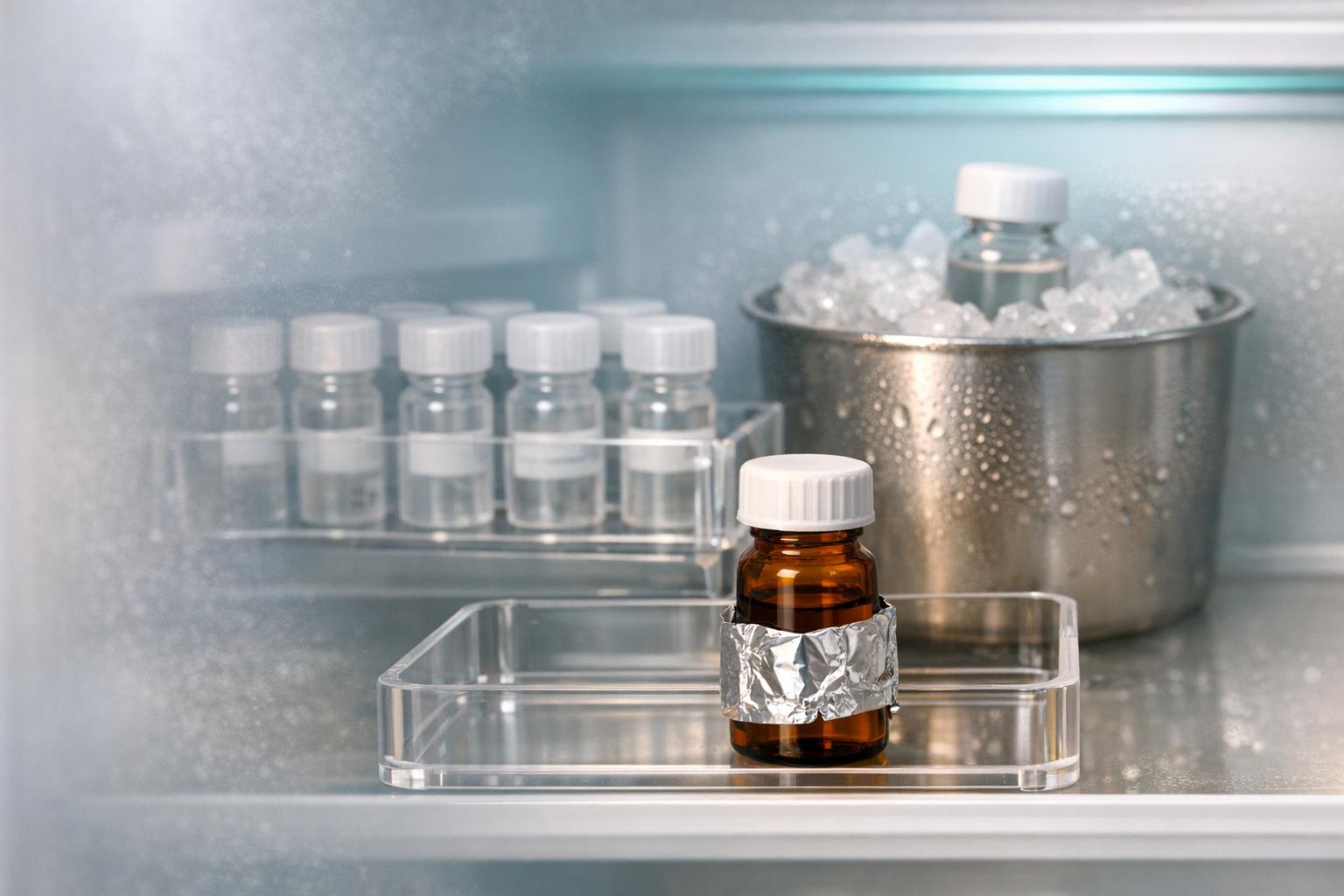
Amber glass vials are ideal because they block harmful UV and blue light. If you only have clear vials, wrap them in aluminum foil or store them in an opaque container to shield the contents. Use airtight crimp or screw caps to keep out oxygen and moisture. Always store vials upright with the stopper facing up - this prevents prolonged contact between the solution and the rubber stopper, which could cause unwanted material to leach into the peptide.
Desiccants and Inert Gas
Humidity control is critical, especially for lyophilized peptides. Adding silica gel packets to a secondary airtight container can absorb excess moisture and keep the powder from clumping. Aim to maintain humidity levels between 20% and 60%. For peptides containing sensitive amino acids like methionine or cysteine, consider using inert gases like nitrogen or argon to displace oxygen before sealing the vial. While this requires specialized tools, it’s a solid option for long-term storage in labs or professional setups. With the right containers and moisture precautions in place, the next step involves dialing in the proper storage temperature.
Step 3: Set the Right Temperature
Peptide Storage Temperature and Shelf Life Guide
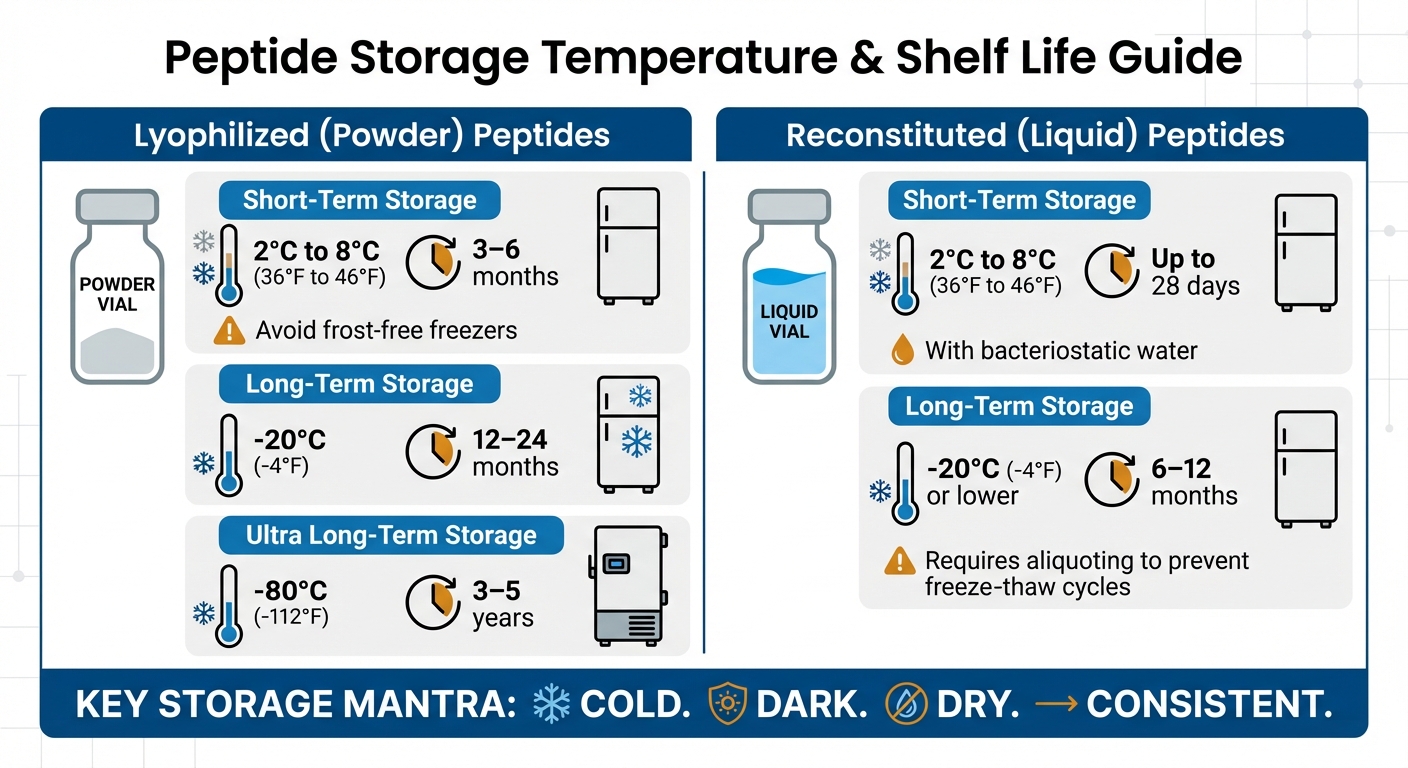
Now that you've got the proper containers ready, the next step is all about creating a stable temperature environment. Why is this so important? Because temperature has a direct impact on peptide stability. For instance, lyophilized peptides can retain at least 95% of their integrity for 12–24 months when stored at -20°C (-4°F). On the other hand, reconstituted peptides start breaking down within hours if left at room temperature. Keeping a consistently cold environment is key since temperature fluctuations can stress peptide structures and speed up their degradation.
"Cold. Dark. Dry. Consistent."
– Xcel Peptides
Temperature Guidelines for Dry and Lyophilized Peptides
If you're storing lyophilized peptides for the long haul, a freezer set between -20°C to -80°C is your best bet. At -20°C (-4°F), these peptides usually stay stable for 12–24 months, while dropping the temperature to -80°C (-112°F) can extend their shelf life to 3–5 years. For short-term storage (3–6 months), a standard refrigerator at 2°C to 8°C (36°F to 46°F) works fine.
For personal use, most home freezers operating at around -20°C are sufficient. However, steer clear of frost-free freezers. Their automatic defrost cycles can cause micro-thawing, which compromises peptide stability. Another tip: store vials on the back shelf of the freezer. This area experiences fewer temperature swings compared to the door, where fluctuations of 5°C to 10°C (9°F to 18°F) occur every time the door is opened. And remember, to avoid condensation, let frozen vials sit at room temperature for 10–15 minutes before opening them.
Temperature Guidelines for Reconstituted Peptides
Reconstituted peptides are much more delicate than their dry counterparts. Once reconstituted, they should be refrigerated at 2°C to 8°C (36°F to 46°F) and used within 28 days. For longer storage, freeze them at -20°C (-4°F) after dividing into aliquots to prevent freeze-thaw cycles. Using a standalone thermometer can help ensure your storage temperature stays consistent.
Why avoid freeze-thaw cycles? They can lead to the formation of ice crystals, which damage the peptide structure. Also, keep in mind that the type of water used for reconstitution matters. Peptides mixed with bacteriostatic water (which contains preservatives) can last up to 28 days in the fridge. However, those reconstituted with sterile water - lacking preservatives - may only remain stable for 24–48 hours.
| Peptide Form | Short-Term Storage | Long-Term Storage |
|---|---|---|
| Lyophilized (Powder) | 2°C to 8°C (36°F to 46°F) for 3–6 months | -20°C to -80°C (-4°F to -112°F): 12–24 months at -20°C; 3–5 years at -80°C |
| Reconstituted (Liquid) | 2°C to 8°C (36°F to 46°F) for up to 28 days | -20°C (-4°F) or lower for 6–12 months (requires aliquoting) |
Step 4: Shield Peptides from Light, Temperature Changes, and Contamination
To keep peptides effective, you need to protect them from three major threats: light exposure, freeze-thaw cycles, and contamination. Even with proper peptide storage temperatures, these factors can still harm peptide integrity.
Reduce Light Exposure
UV light can trigger the formation of hydroperoxides, which speed up peptide degradation. This process is especially harmful to aromatic amino acids like Tryptophan and Tyrosine, with Tryptophan being particularly sensitive due to its higher light absorption at 280 nm - nearly four times greater than Tyrosine’s. Peptides exposed to UV-C radiation at 254 nm may unfold, form dimers, or aggregate. In collagen-based peptides, UV-C exposure for 66 hours can weaken their structure by 23.6% to 35.6%. Even high-energy blue light can disrupt peptide stability during handling.
How to protect peptides from light:
- Keep vials in their original cardboard boxes for a built-in light barrier.
- If the box is unavailable, wrap vials in aluminum foil to block light completely.
- Avoid leaving peptides on countertops or near windows where they might be exposed to sunlight.
- When handling peptides, work in a dimly lit area to limit light exposure.
- Consider using amber glass vials, which filter harmful wavelengths while still allowing visibility of the contents.
Light is only part of the problem - temperature fluctuations, particularly freeze-thaw cycles, can also damage peptides.
Prevent Freeze-Thaw Cycles
Repeated freezing and thawing stresses peptides by forming ice crystals, which can damage their structure. The mechanical stress from expanding and contracting ice can break amino acid chains, especially in larger peptides like IGF-1 LR3 or HCG, which have more delicate structures.
"Each freeze-thaw cycle can cause physical stress to the lyophilized cake. If you need multiple portions from one vial, reconstitute the entire vial once and aliquot into individual-use volumes."
– Apex Laboratory
Solution: Aliquoting. Divide your reconstituted peptide into single-use portions using sterile microcentrifuge tubes. Freeze these aliquots and thaw only what you need at a time. This ensures peptides are exposed to minimal temperature fluctuations, preserving their structure.
Stop Contamination
Contamination is another major risk to peptide effectiveness. Without sterile handling, bacteria can grow in peptide solutions within hours. Always use a new, sterile syringe and needle for each draw, and disinfect the rubber stopper with an alcohol swab before puncturing it.
The type of water used for reconstitution matters, too. Bacteriostatic water, which contains 0.9% benzyl alcohol, prevents bacterial growth for up to 28 days. In contrast, plain sterile water lacks preservatives, allowing bacteria to multiply quickly after the first use. Mark the first use date on your vial and discard any reconstituted solution after 28 days, even if it appears clear.
For lyophilized peptides, moisture is a common enemy. To prevent degradation:
- Use desiccants to absorb humidity.
- Let frozen vials warm to room temperature before opening to avoid condensation inside.
- Some advanced users reseal vials with inert gases like nitrogen or argon to displace oxygen and reduce oxidative damage.
Finally, inspect peptides before use. If the solution looks cloudy, discolored (yellow or brown), or contains floating particles, discard it immediately. These visual changes indicate the peptide may no longer be safe or effective.
Step 5: Avoid Common Storage Mistakes
Even with the best storage practices, certain missteps can quickly ruin your peptides. The most frequent issues stem from temperature mishandling, moisture exposure, and poor handling techniques. These errors can turn a high-quality peptide into an ineffective solution in no time.
Temperature Fluctuation Problems
One of the biggest mistakes is storing reconstituted peptides at room temperature. Heat speeds up chemical degradation and creates a breeding ground for bacteria, making your peptide solution unusable. Another common misstep is relying on a "frost-free" kitchen freezer for long-term storage. These freezers cycle between temperatures to prevent ice buildup, which can destabilize peptides over time.
Opening a frozen vial immediately after removing it from the freezer is another harmful practice. The sudden exposure to warm, humid air causes moisture to condense inside the vial, leading to hydrolysis and clumping. To avoid this, always let frozen vials sit at room temperature before opening.
As mentioned earlier, only reconstitute what you plan to use within the recommended timeframe. For consistent storage conditions, keep peptides in the back of your refrigerator or freezer, away from the door where temperature fluctuations are more likely.
Moisture and Contamination Problems
Moisture is a major threat to lyophilized peptides, especially those containing Aspartic acid, Glutamic acid, Lysine, Arginine, or Histidine. These amino acids absorb moisture from the air, causing the powder to clump and degrade - a process known as deliquescence.
To protect peptides from moisture, use desiccant packets as suggested in Step 2 and avoid storing them in humid areas like bathrooms or kitchens. For added protection, some users purge vials with nitrogen or argon gas after use to displace moisture-laden air. Always handle vials with gloves to prevent contamination from skin oils or enzymes.
Handling Errors
Improper handling can damage peptides just as much as temperature and moisture. Never shake peptide vials, as this can denature their structure. Instead, gently swirl or roll the vial between your palms to mix the solution.
Another common mistake is storing vials on their side. This increases contact between the solution and the rubber stopper, which can leach unwanted materials into the peptide.
Reusing syringes is also risky, as it introduces bacteria that can multiply rapidly in liquid solutions. To stay organized, label each vial with the peptide name, concentration, and reconstitution date so you can track its 28-day usability window. If you notice cloudiness, discoloration (yellowing or browning), or floating particles in the solution, discard it immediately - these are clear signs of degradation.
"A compound that was manufactured at ≥99% purity can degrade to unusable levels within days if stored incorrectly."
– Apex Laboratory
Avoiding these common mistakes is just as important as following proper storage guidelines. It ensures your peptides remain effective and safe for use.
Conclusion
Proper peptide storage is simple if you stick to the right steps. As Apex Laboratory explains: "A compound that was manufactured at ≥99% purity can degrade to unusable levels within days if stored incorrectly - while the same compound stored properly can remain stable for months or even years". This highlights the importance of following the storage practices outlined earlier.
The basics are clear: keep lyophilized peptides in the freezer at around -20°C (-4°F) for long-term stability. For reconstituted peptides, refrigeration at 36–46°F is key, and freezing them is a no-go. Use sterile vials, add desiccants to manage moisture, and stick to the mantra: "Cold. Dark. Dry. Consistent". These simple principles form the backbone of effective peptide storage.
To further protect peptides, wrap vials in aluminum foil to block light and avoid temperature fluctuations that can lead to freeze-thaw cycles or contamination. Maintaining cleanliness is equally important, as it helps shield peptides from heat, moisture, light, and oxygen.
Keep in mind that once reconstituted with bacteriostatic water, peptides should be used within 28 days, as this is the sterility assurance window for bacteriostatic water after a vial has been punctured. Label every vial with details like the name, concentration, and reconstitution date to stay organized.
Investing in quality containers, desiccants, and sterile vials is a small price to pay to preserve your peptides and avoid unnecessary waste. By following these straightforward steps, you ensure the effectiveness and value of your peptide treatments.
FAQs
How can I tell if a peptide has gone bad?
Peptides that have degraded often show visible signs like discoloration, cloudiness, or the formation of precipitates. Another clue is a noticeable drop in effectiveness or a failure to deliver the expected results, which can signal instability. To avoid this, store peptides in a cool, dark environment, keeping them away from moisture, light, and air exposure. Proper storage not only preserves their stability but also makes it simpler to identify when they are no longer viable.
Can I travel with peptides without ruining them?
Yes, you can travel with peptides, but you need to handle them carefully to avoid degradation. Peptides are particularly sensitive to factors like temperature, light, moisture, and oxygen. To keep them stable, store them in a refrigerator at 36–46°F (2–8°C). When traveling, use insulated containers with desiccants to shield them from heat, light, and humidity. Minimize exposure by handling them quickly and keeping them in a cool, dark place during transit.
What should I do if I accidentally left a peptide out?
If a peptide solution has been left at room temperature, it’s probably degraded from exposure to heat, light, or moisture - it’s best to discard it to avoid any loss in effectiveness. On the other hand, lyophilized peptides (in powder form) might still be stable if they’ve been kept dry and cool. To preserve their integrity, limit exposure to air and humidity, and store them in an airtight container at -20°C or colder to prevent further breakdown.